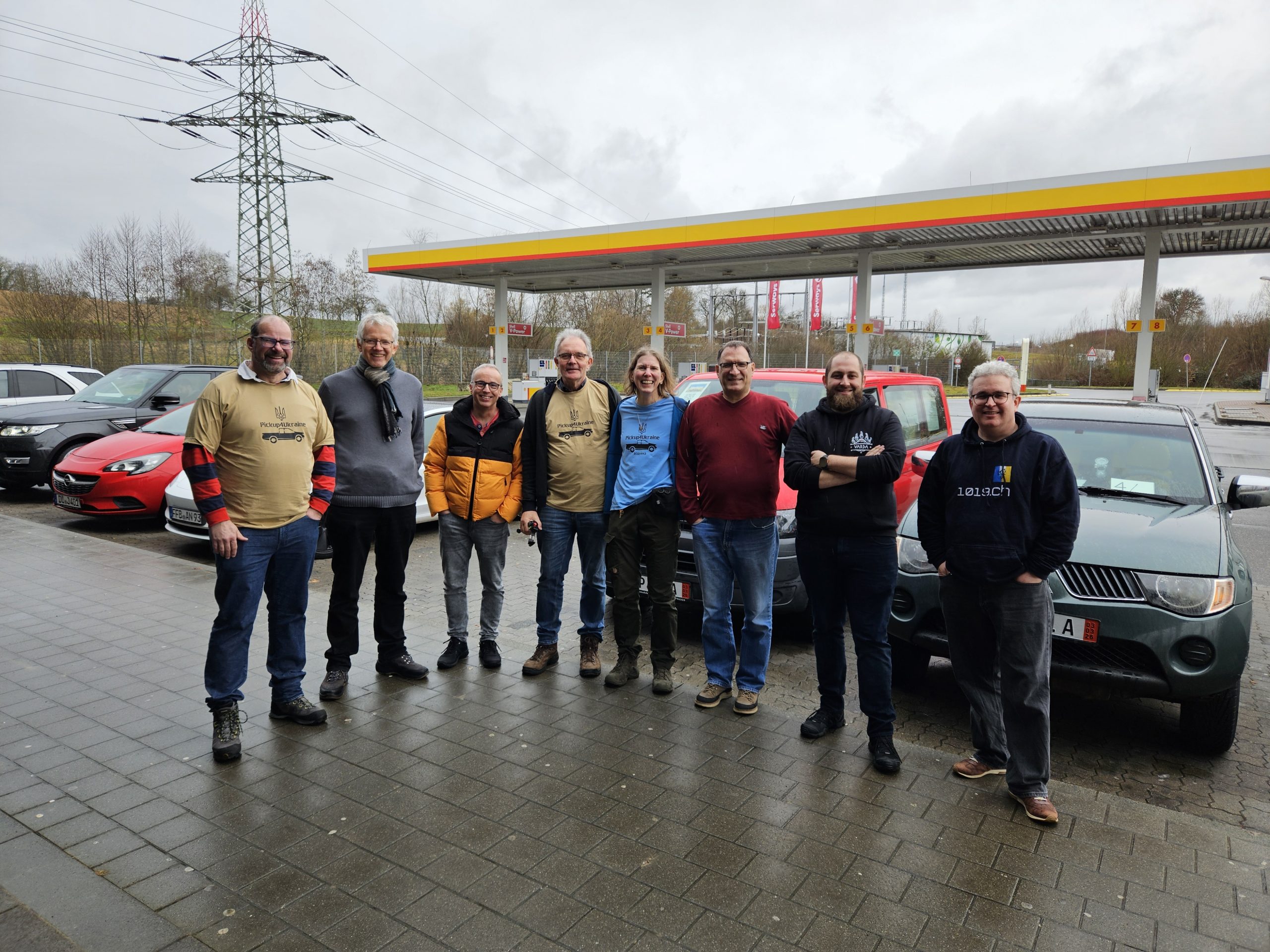
What a surreal week I’ve just had. Six days in a convoy to Kyiv, handing over vehicles and returning by train and plane, then four days working in the office, and now on my way to Hawaii for the annual company celebration of the field organization. I consider myself incredibly lucky to have been nominated – that’s really rare for employees outside the sales organization – and at the same time, I don’t feel like celebrating. A song by Midnight Oil from my youth keeps coming to mind. “How can we sleep while our beds are burning, how can we dance while the world is turning?” I keep reminding myself of what my SAP colleague Alena in Kyiv told me: “You have to celebrate, too. You have to enjoy yourself. I go to the gym regularly and – when possible – two to three times a week to the theater.” Now, in the plane, I’m starting to write, from memory, the report about our 19th transport to Kyiv.
Preparations
As we say in German: After the game is before the game. Already in December, right after our 18th trip, we look at our waiting list and at the same time at our donation budget, and we begin searching for suitable vehicles in direct contact with the units. Our partner organization 1019.ch is also participating again with funding for evacuation vehicles. Thanks to the help of our now established group of car scouts, we quickly manage to buy several vehicles, and our friend Roman soon has his hands full in his workshop, checking cars and in some cases getting them back into working order.
We are aiming for a large transport at the end of February with at least 10 vehicles, and at the end of January we realize that we could even organize 12. We already have commitments from drivers. However, professional appointments come up for me, including workshops and this invitation to Hawaii. After some weighing and discussion, we decide to split up the convoy. I suggest to our group of fellow drivers, instead of the planned date at the end of February, two dates with a subgroup of vehicles each. I will handle the 19th transport starting February 11 with four vehicles (a VW T5, a KIA Sorento, a Ford Ranger, and a Mitsubishi L200), and Michael will handle the 20th transport two weeks later with another eight vehicles. We are lucky, and we find exactly the right number of drivers to be able to staff each vehicle with two people all the way to Kyiv. Among the total of 24 drivers for the 12 vehicles, there are many old hands but also some new faces. For transport 19, Malte, Jürgen, Martin, and Niklas from Switzerland sign up, as well as Heiko, Stefan, and Stephan, who are joining for the first time. Preparation calls are set up, and the remaining days until departure are filled with a lot of logistics. Stefan donates, among other things, a small generator, a walker, and crutches, Dani brings a wheelchair and more walking aids, a filled first responder backpack, as well as nuts and foot warmers. Michael is able to receive a large number of syringes from Roland in Speyer, which were donated to us by a hospital in Speyer. We load part of them into the VW T5. The vehicles are brought to the workshop one after another, picked up again, get their license plates for export, and we distribute them among the drivers. Finally, we meet for loading in Walldorf and fill sorted hospital supplies and boxes full of heating candles into the VW bus and the pickups. Then comes the day of departure. Unlike before, we have decided that, given the still wintry road conditions and weather, we will split the first leg into two stages. So we do not start early Thursday morning, but already on Wednesday afternoon, aiming for a 6-7 hour drive only to the Polish border.
Wednesday, 11 February
We leave the Kraichgau Süd rest stop at 1:30 p.m.; there is a lot of rain, but also daylight and well-rested drivers. A clear difference from usual! One vehicle suddenly won’t start, but a randomly present ADAC helper is able to get the key into position in the worn ignition. Later on during the drive, a few hiccups occur—but that’s also an advantage of short stages—we can calmly discuss possible causes with Roman and adapt. Just past the Polish border, we head first to the gas station and then directly to the hotel where we would spend the night. Delicious dinner, and then a quiet night.
Thursday, 12 February
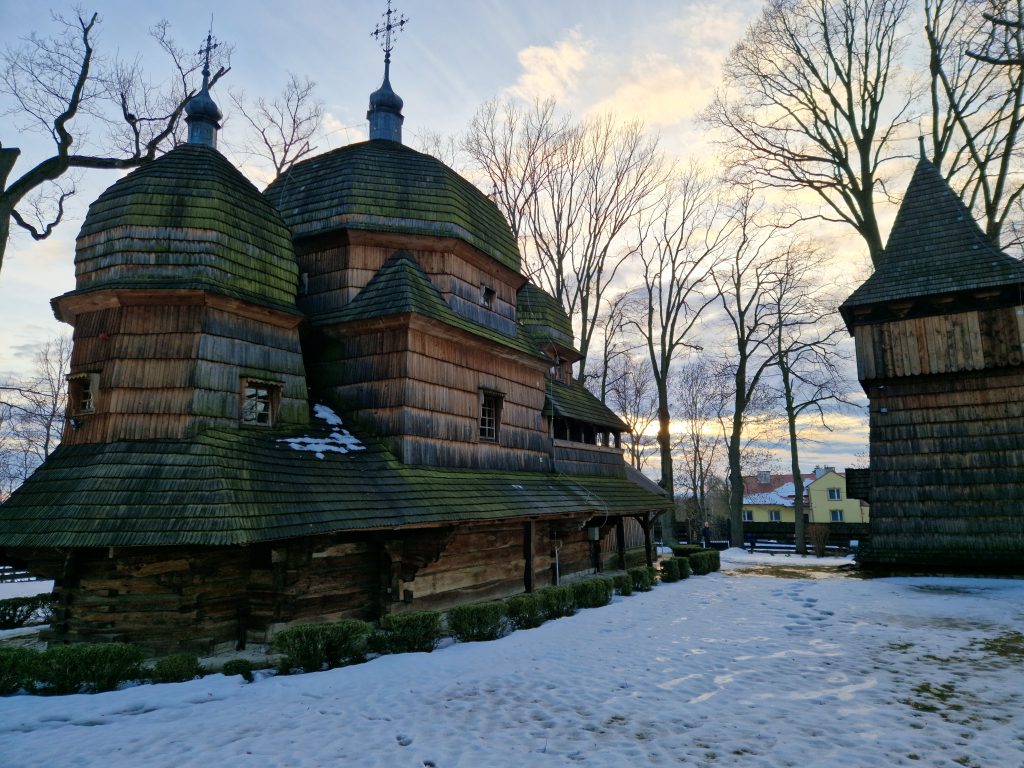
Early in the morning, I can quickly get the Ukrainian customs documents from Lawyers Move printed by the hotel reception. There had been a system failure, so we only received them at the very last minute. After a relaxed breakfast, we then set off toward the Ukrainian border. When I see the first signs on the side of the highway with the entry “Korczowa,” indicating the distance to the border crossing, my heart always warms, as usual. The drive through southern Poland is uneventful, with sunny, mild weather and no rush hour traffic—we simply happen to be in the Kraków region at the right time of day. The further we drive into the country, the more we see the remnants of the harsh winter that had a firm grip not only on regions in Ukraine but also on southeastern Poland in recent weeks. Lots of snow, now of course wet and melting at 54°F. We make good progress, and so we decide to visit the wooden Greek catholic church in Chotyniec before our stop at the customs agency in Radymno. Michael showed the church to me for the first time on our second trip—about three years ago. A rounded building from the 17th century, covered with wooden shingles, with low rooms, small windows, and—in the mild air, damp from the thawing snow—an intense scent of wood.
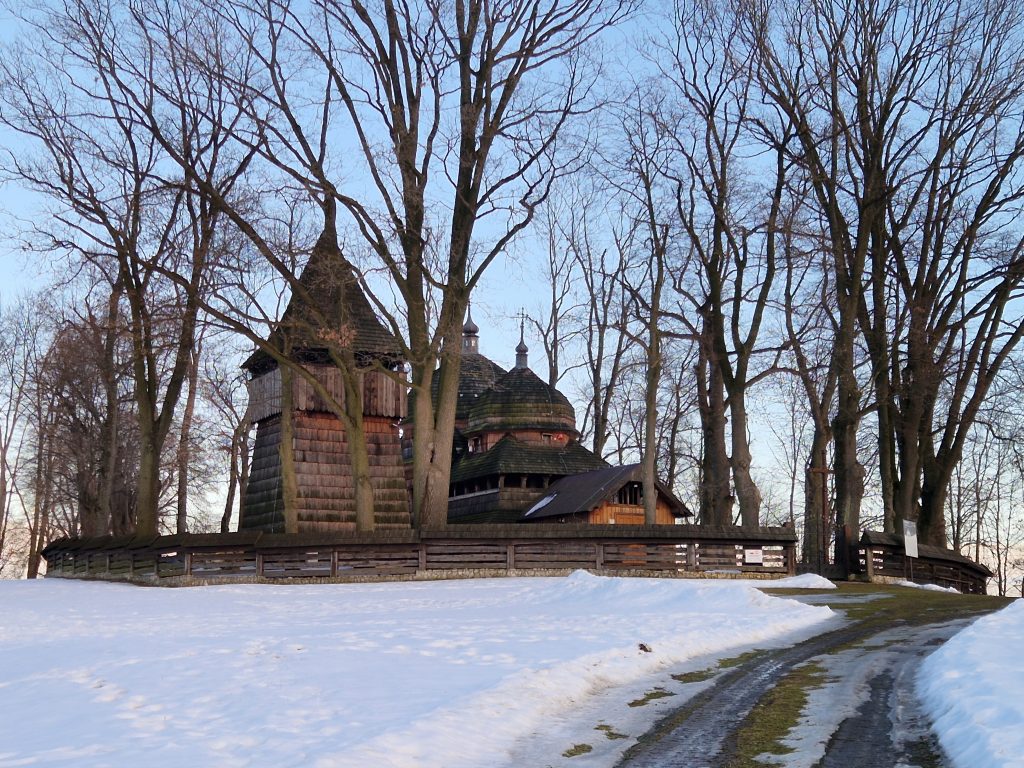
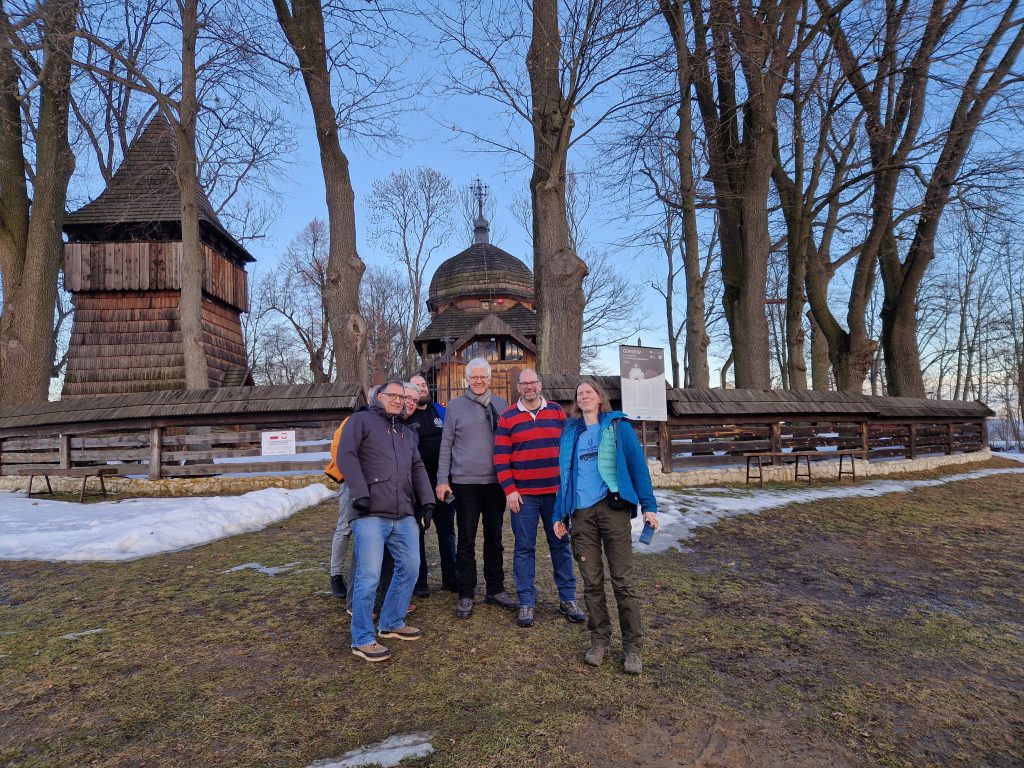
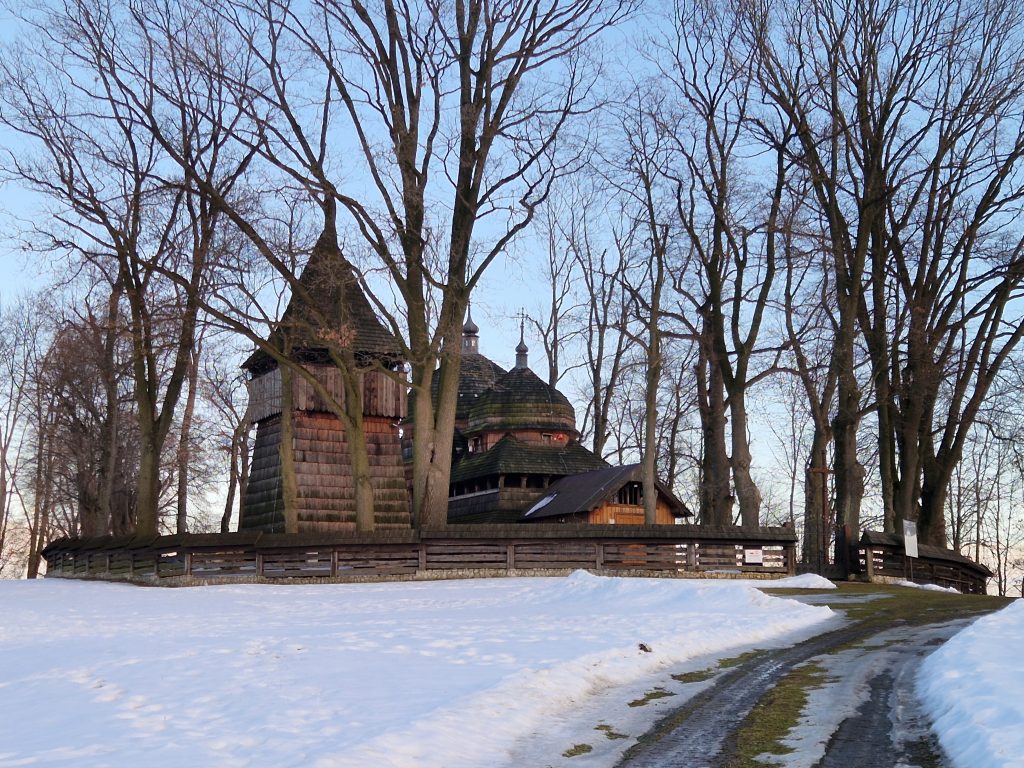
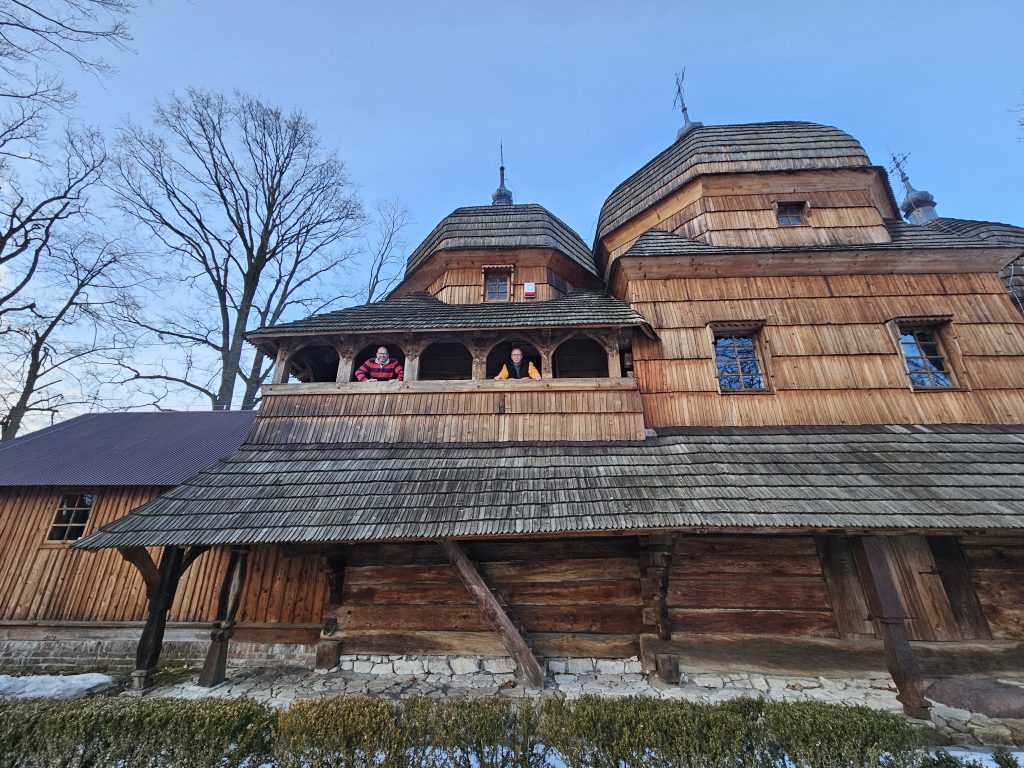
In the last rays of sunlight, we take the group photo in the evening, then I walk to the customs agency and apply for the export documents. I feel a bit uneasy. This is typically Michael’s task, but this time I am alone. I don’t speak Polish. I’ve prepared a few sentences on DeepL and practiced the pronunciation. But no lengthy explanation is necessary. They find our organization in their system, and everything is processed.
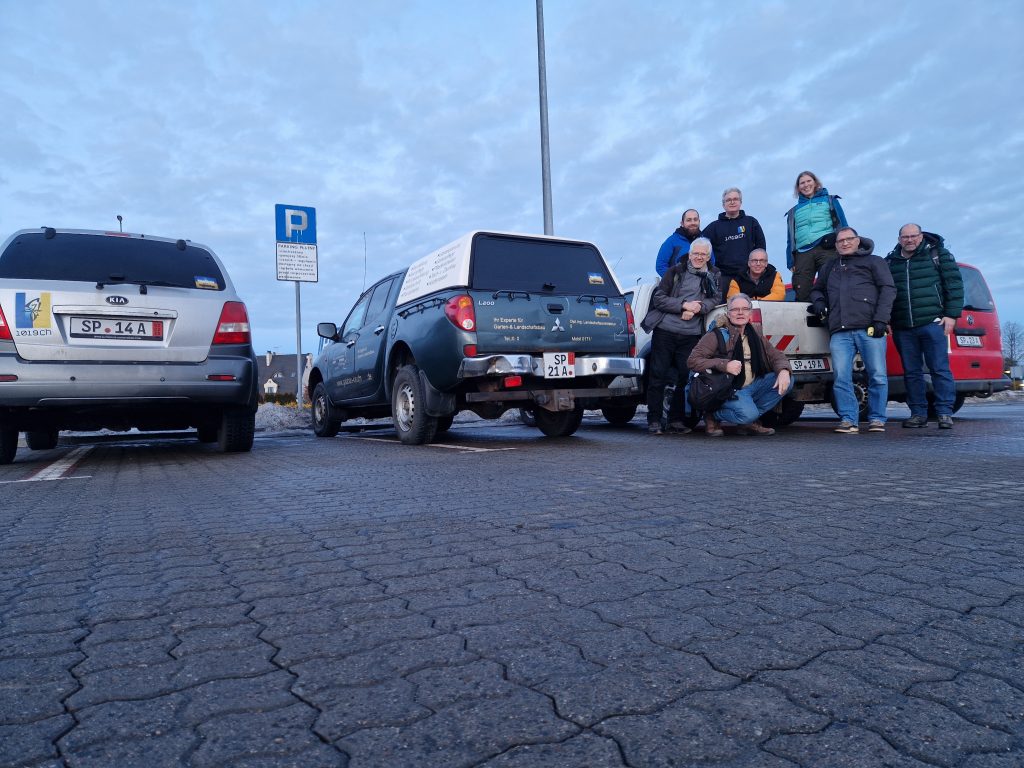
Outside in the parking lot, a man pulls up to us in his car and asks if we’re going to Ukraine. He says he has isotonic drinks for the people at the front and wonders if we could take them with us. I politely decline, citing customs regulations—but actually, it’s rather about not taking things or food from random strangers. You never know.
We check into the hotel, the customs documents are ready 1.5 hours later, dinner is delicious as always, everything is great. Now we have completed the stage that we usually manage in 15 hours in one day, easily spread over 1.5 days. The real challenge awaits us on Friday with the border crossing and the drive to Kyiv.
Friday, 13 February
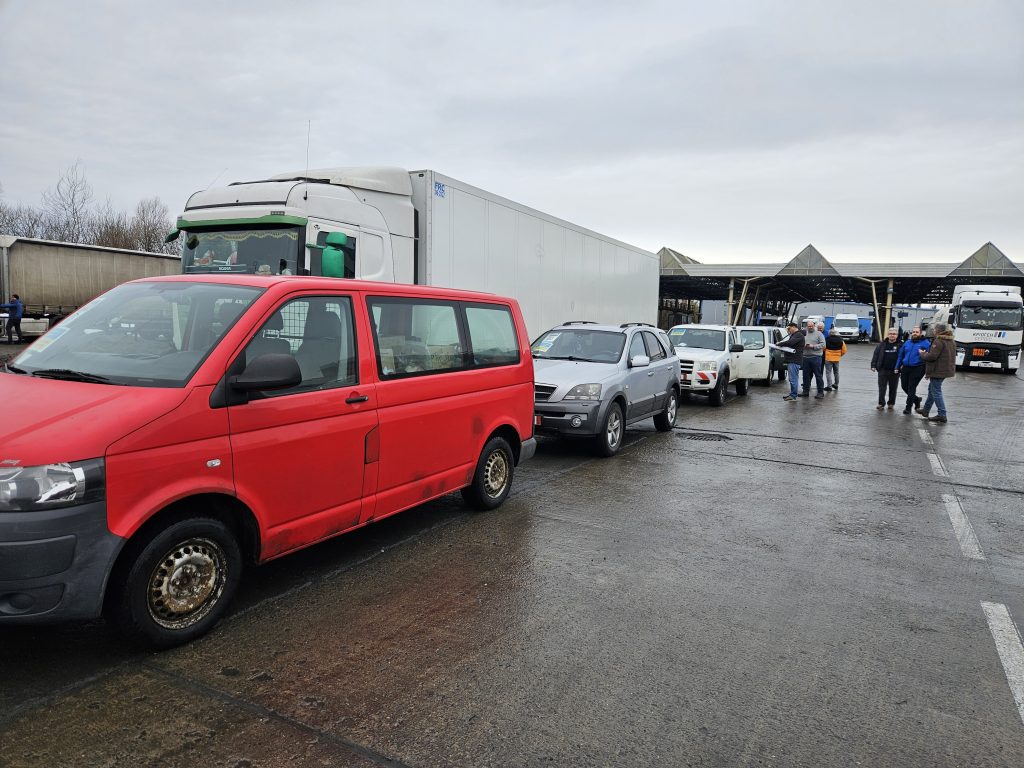
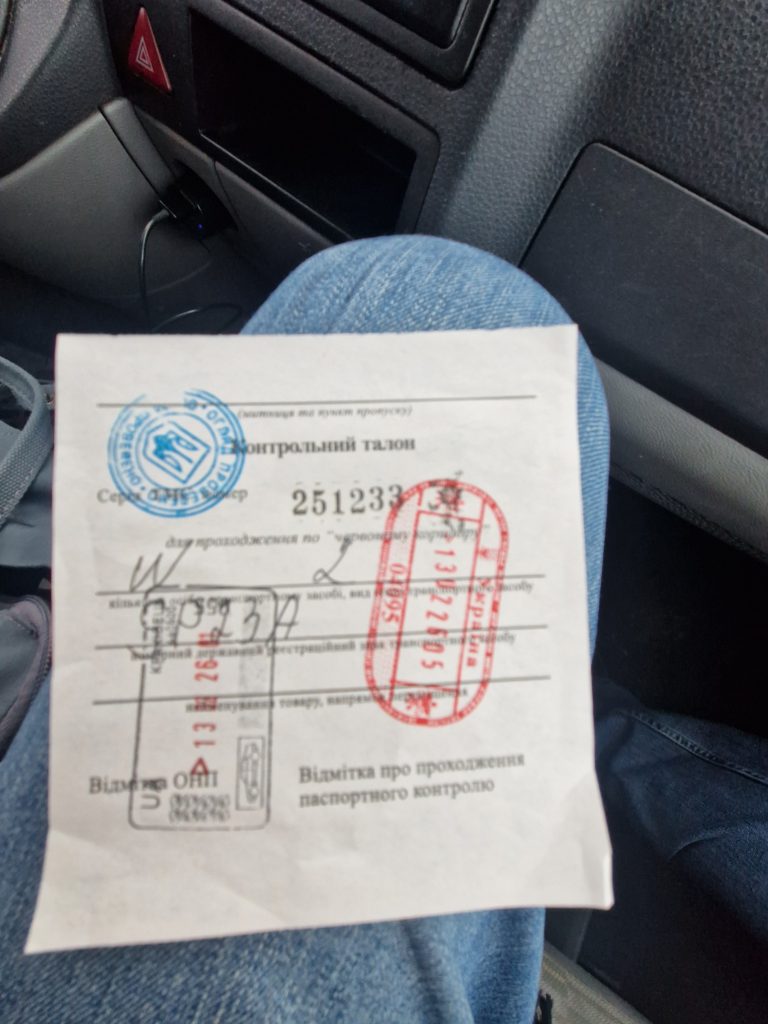
We are already leaving for the border at 7:00 a.m. Everything is fine, no line. A Dutch minibus is being prioritized by the Polish customs officers because it apparently belongs to a group of Red Cross vehicles. However, there are difficulties with its documents, so at some point we are allowed to go ahead and are processed surprisingly quickly and without any problems. We drive to the Ukrainian side and first receive our “talons,” the small routing slips on which you have to collect stamps. So far, always three stamps were required per slip: one before the inspection, one at passport control, and one at customs. So we get through passport control, already have two stamps, park the vehicles between the truck lines, and make our way to the basement to customs.
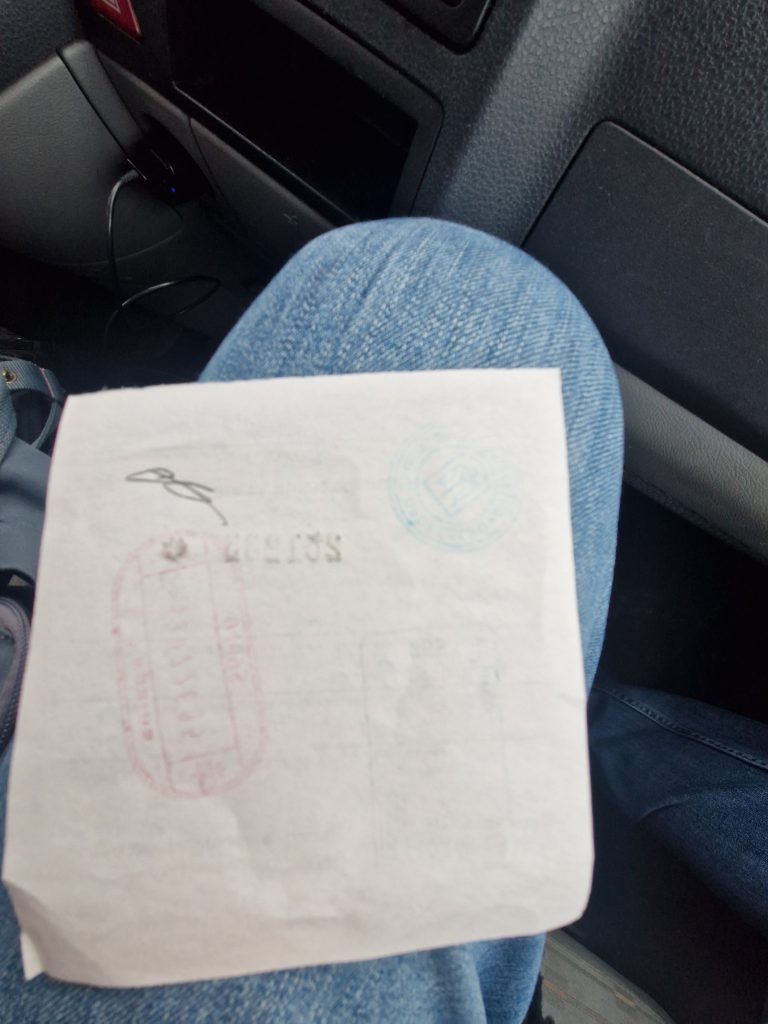
Surprise. We are told, that one more stamp is needed. We need to get it from a “man with a black uniform, anti-smuggling officer”. We climb the stairs back up, get outside below the huge roof of the customs area, and start looking for a man to whom the description fits. The task of collecting stamps reminds me of Pokémon Go – you gotta catch them all. We talk to a man with a black uniform and a dog on a leash, and he refers us to “the last cabin”. We are lucky, the customs officer in that last cabin under the roof is the right person. He walks over to the vehicles, looks into each one of them, asks questions about the cargo and then scribbles his initials on the back of each talon. – One moment: no stamp? We assume, that is correct. With the four pieces of paper signed off, we return into the customs basement and get processed one by one. All good. In total, we probably did not need more than 1.5hrs. We were lucky – especially on Friday 13th.
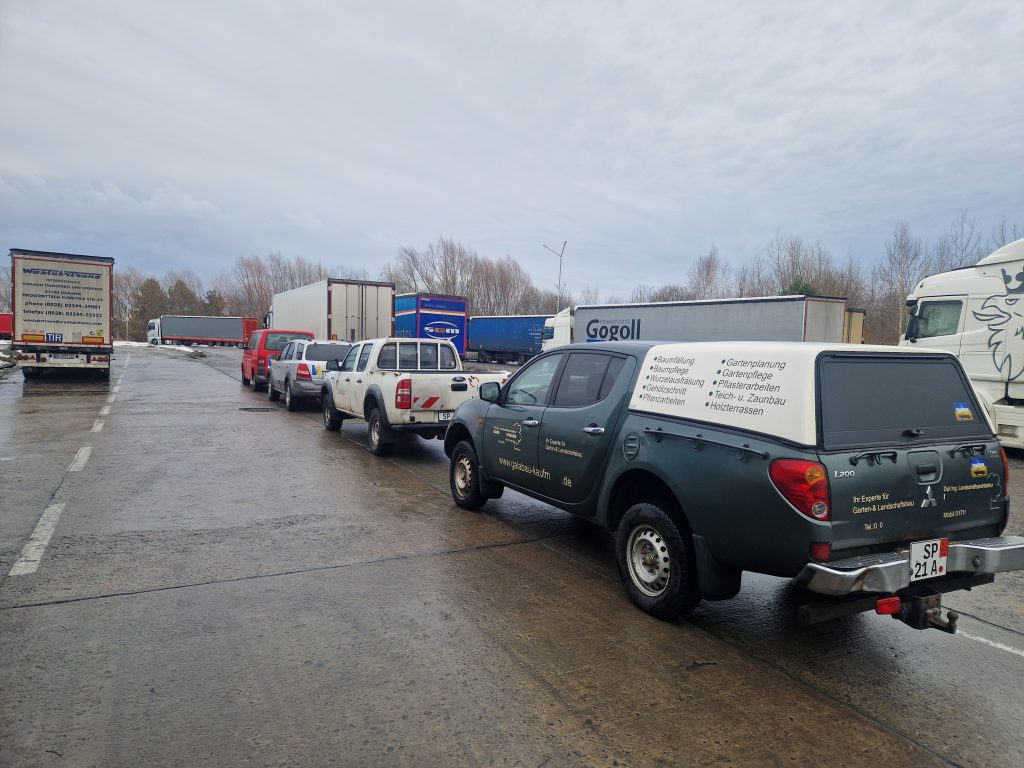
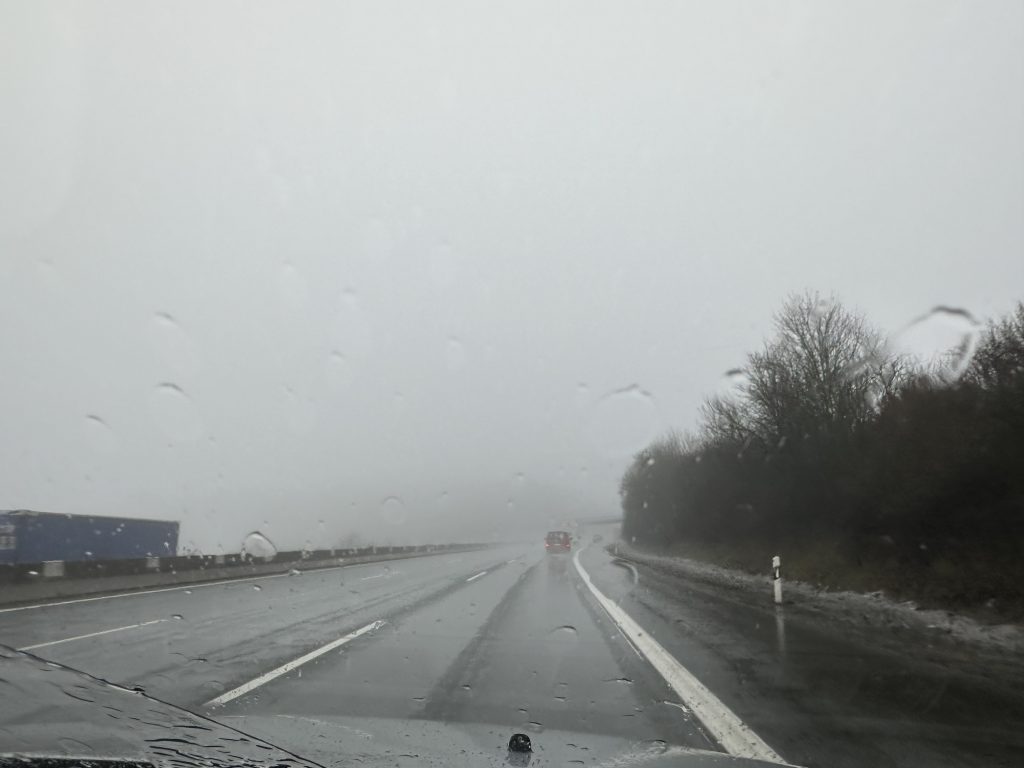
We are heading towards L’viv and notice that the road surface has suffered greatly from the severe frost. It is raining now, but the temperatures are already dropping again. We have the impression that there are many more potholes than in previous years. We drive more carefully than usual. After L’viv, we take a short break, during which all four vehicles regroup, and we continue towards Rivne. Suddenly, the GPS signal is gone. Google Maps tries to locate us, but in vain. In the Signal chat, there is a note about the current air raid alert in the Rivne region; the GPS is being jammed by Ukraine to make it harder for Russian drones to find their targets. I miss the exit to the bypass south of Rivne, realize it, turn around twice, and am back on the correct route. However, I lose the three following vehicles, which instead continue through the city of Rivne. Even without online navigation, we manage. On bare hilltops next to the highway around Rivne, we see pickups with machine guns mounted on the beds for air defense, but still covered due to the drizzle. We do not notice the actual attack, and after Rivne, we meet again at the next rest stop. We continue via Zhytomyr to Kyiv. The roads are cleared, and there are few cars and trucks on the road. The landscape is completely white with a continuous blanket of snow. We reach the outskirts of Kyiv in the dark. The traffic gets a little heavier, and the driving style of the other cars becomes a bit more chaotic.
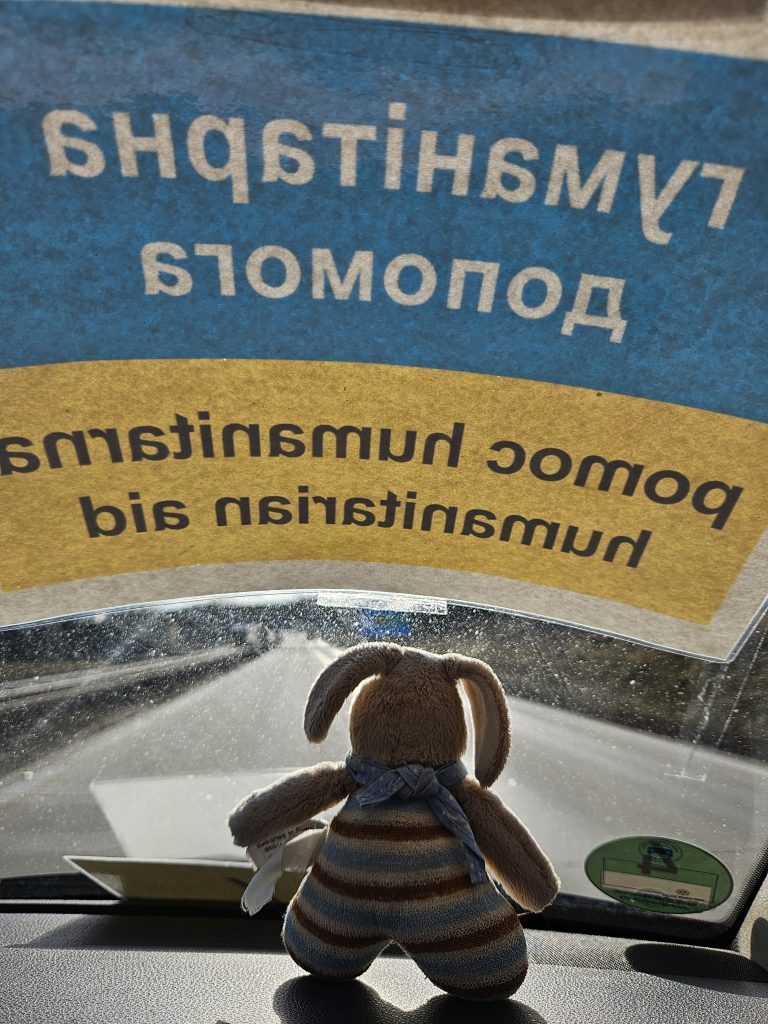
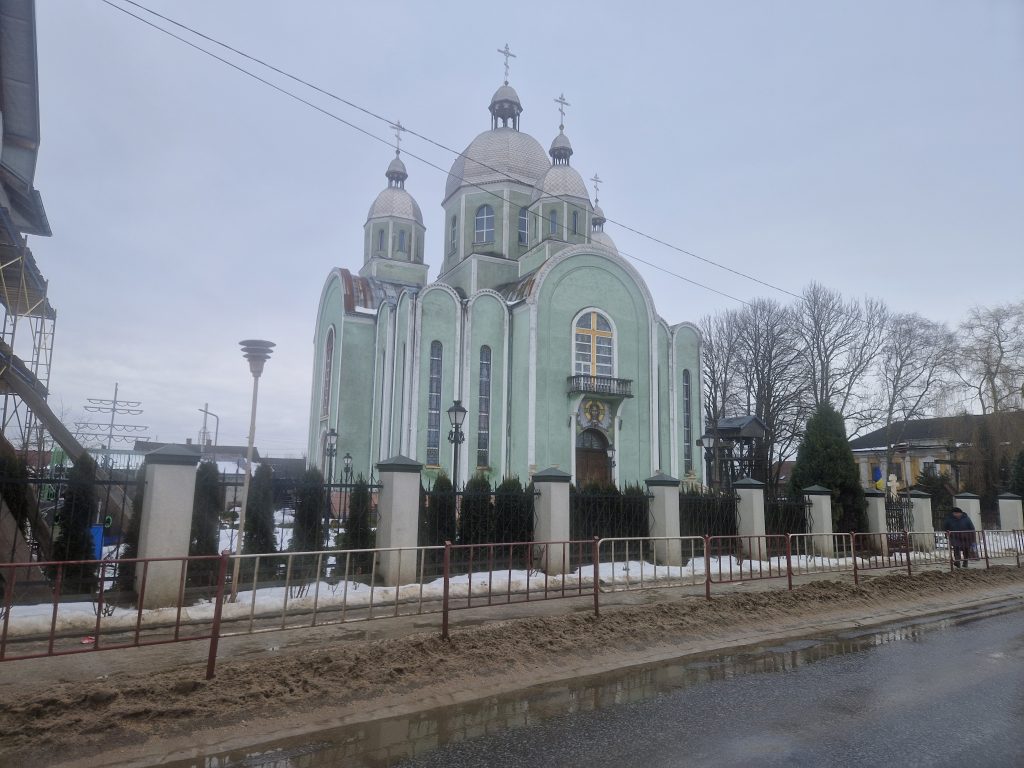
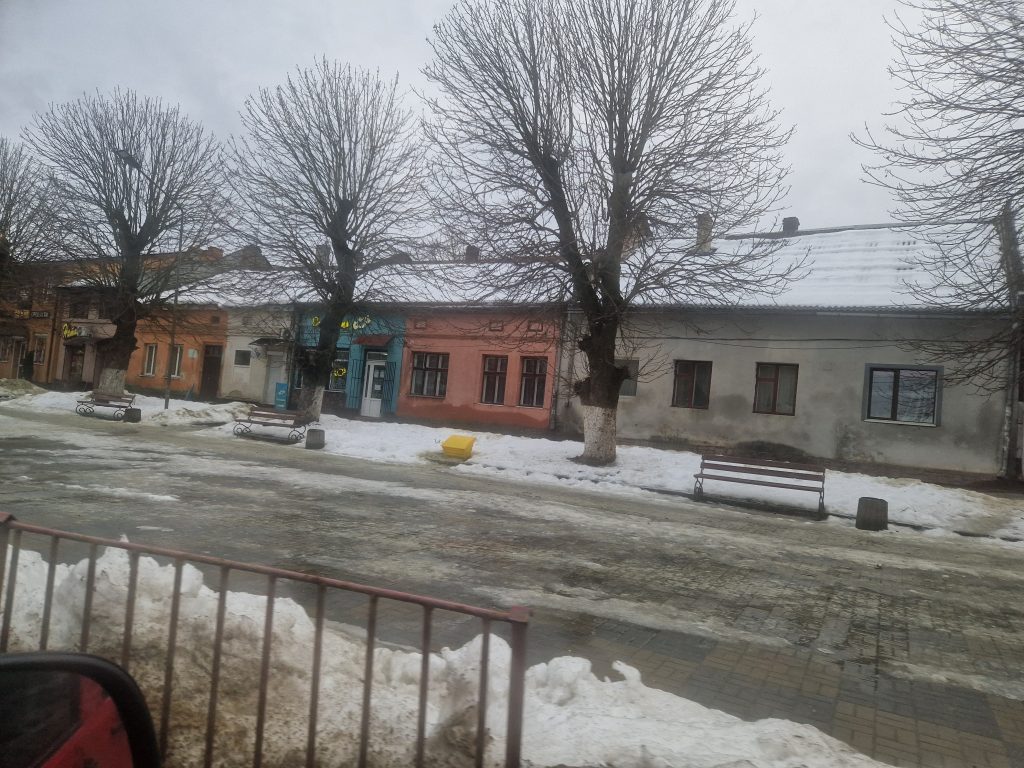
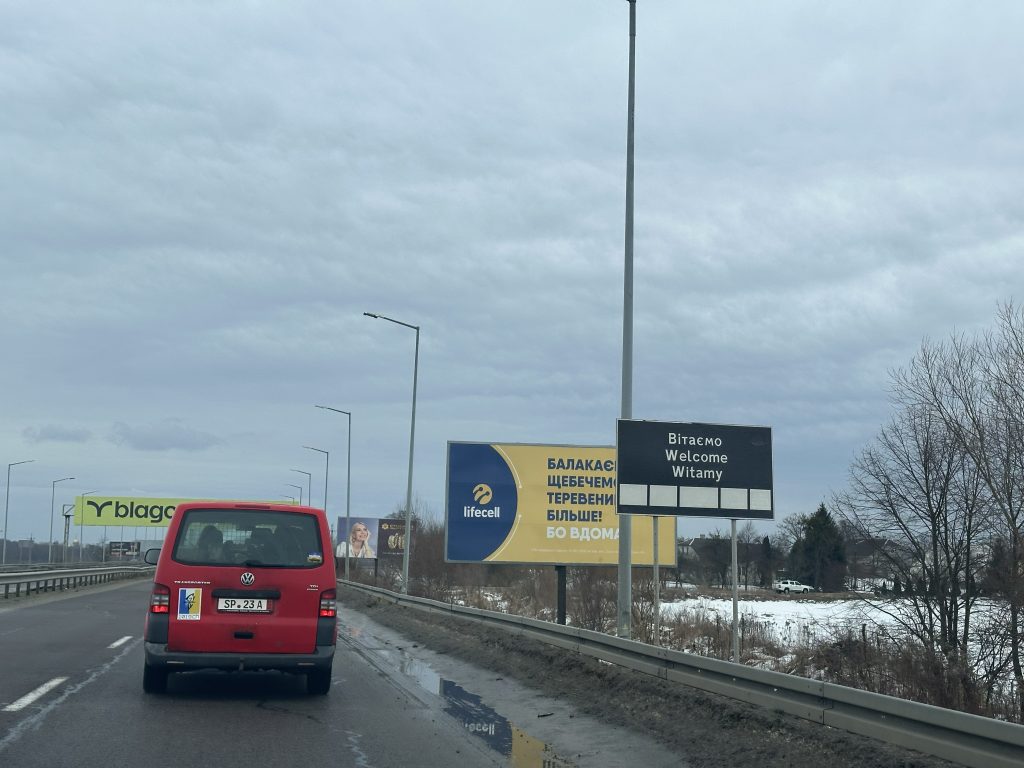
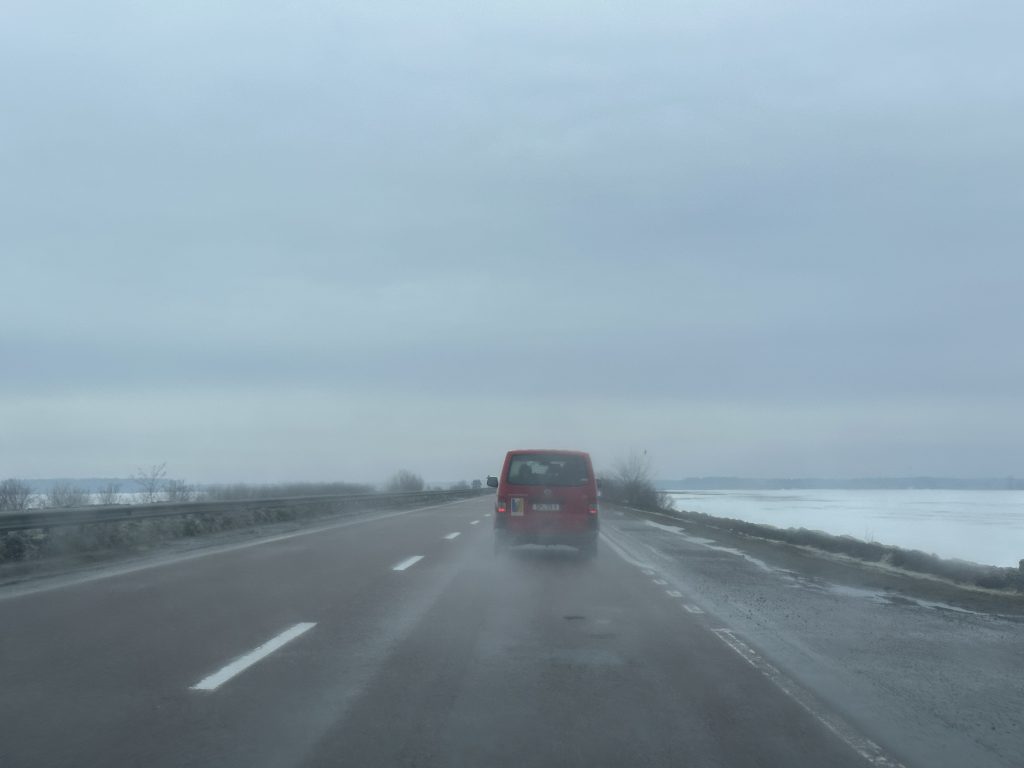
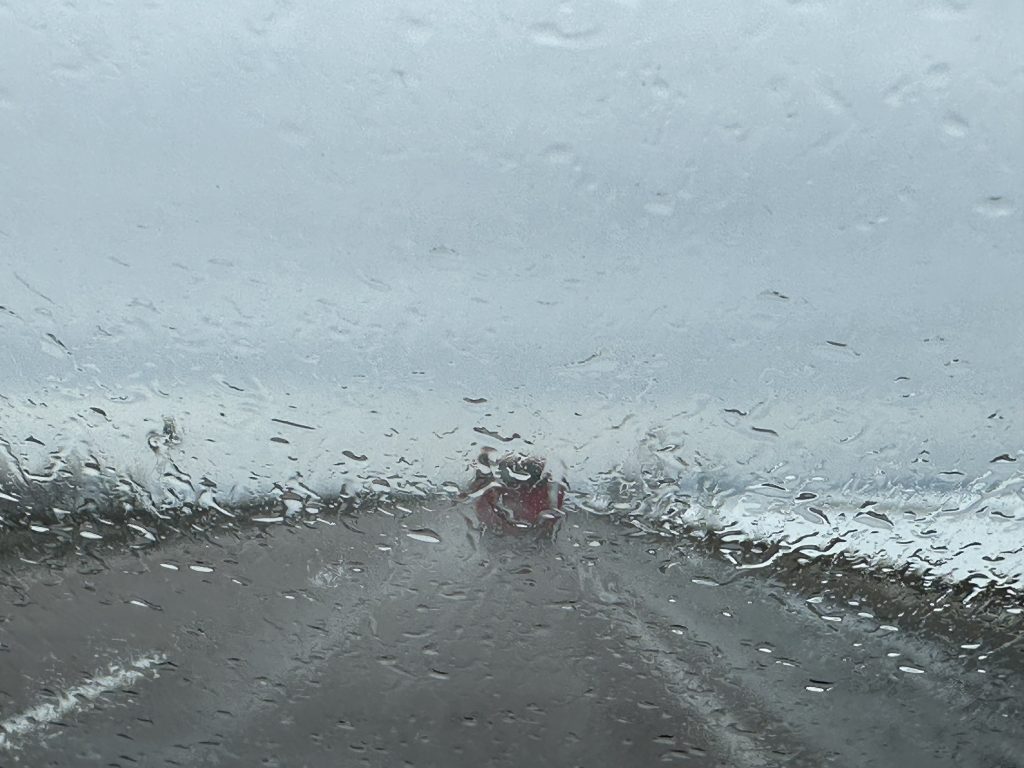
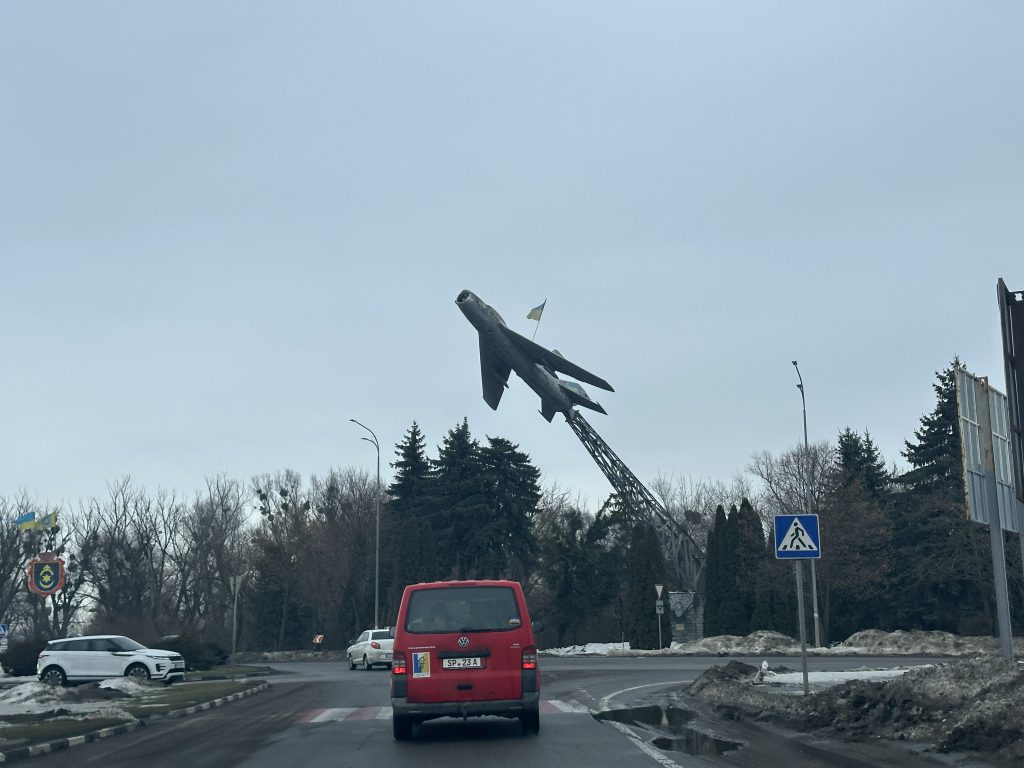
There goes the air alert again, and we navigate using a static map on the mobile. Counting bridges and intersections goes wrong, and so we drive through the city center via Khreshchatyk. The rush hour traffic is less dense. Many people have left the city due to the power outage and are staying outside with friends, relatives, or in their summer cottages.
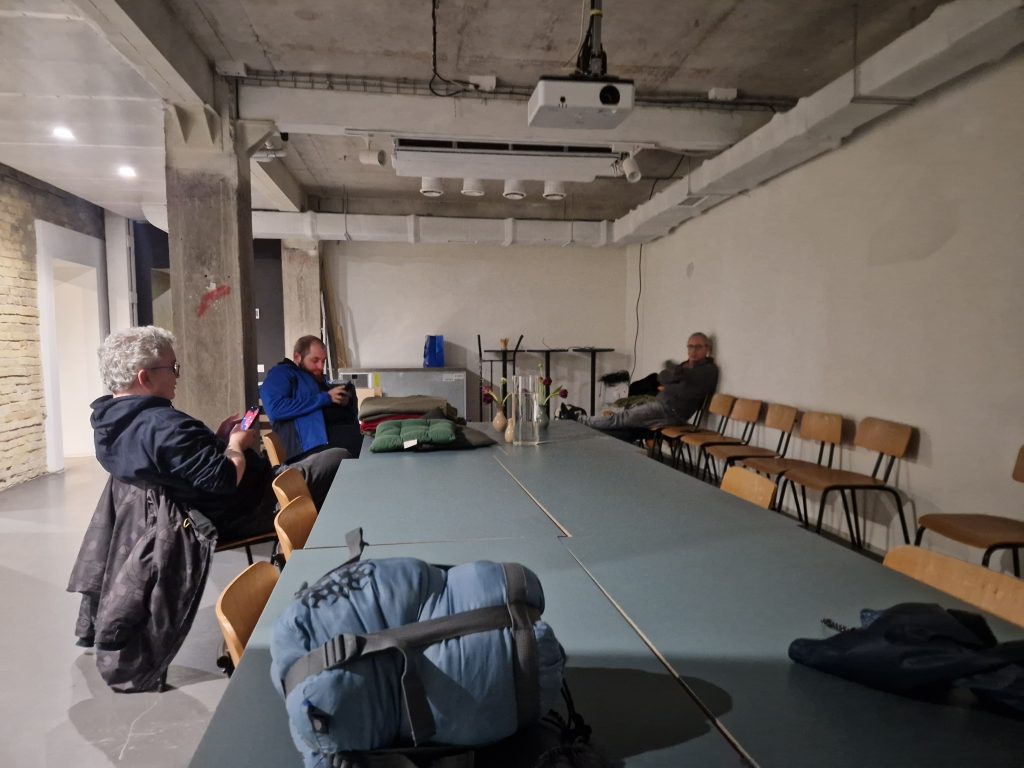
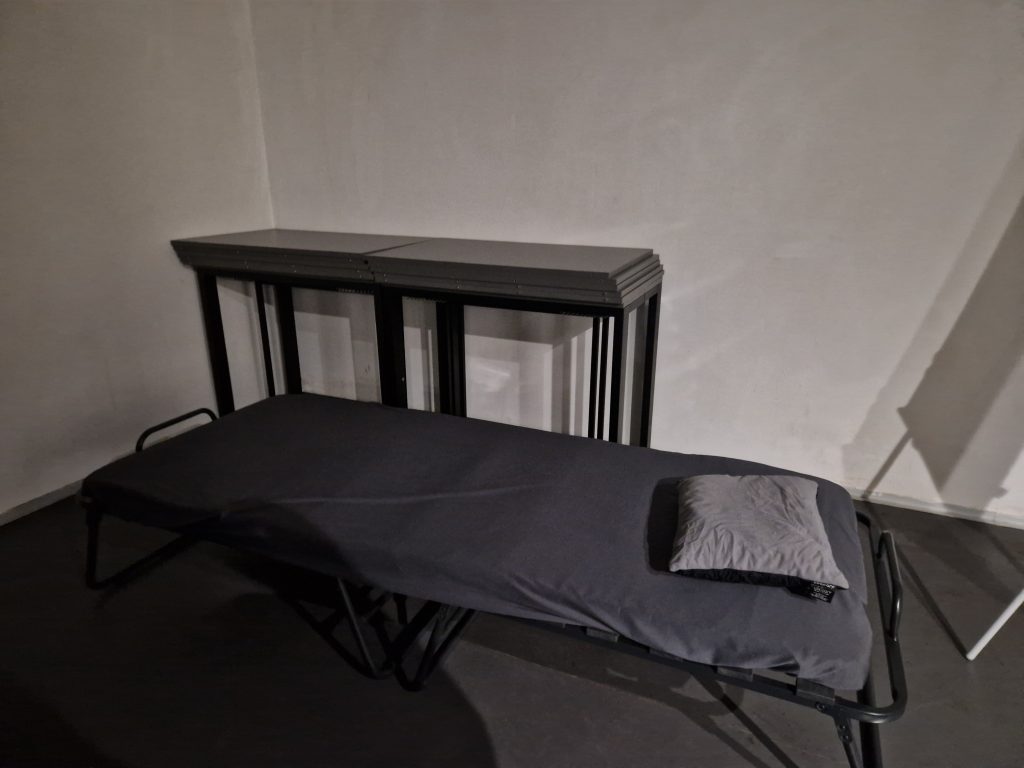
In the evening, around half past eight, we arrive at our destination, Ruslan is at the Hub, our meeting point, and is happy to see us. We park the vehicles and walk to the hotel. We check in, and the young man at the reception explains that thanks to two generators, the hotel has continuous electricity from 8:00 a.m. to 11:00 p.m., and typically also heating and hot water – what a luxury. Even at night, the small lamps above our beds work. We are glad, because that is not a given in Kyiv at the moment. Our SAP colleagues have told us that in their apartments, they sometimes haven’t had heating for weeks, and they hope that the temperature in the rooms doesn’t drop below 43°F. There is electricity for one to two hours a day. Running water, due to the low water pressure in the buildings, only reaches up to the 10th floor, and people manage by showering at the gym and getting drinking water at the supermarket, always bringing the six-packs up to the apartment when the elevator happens to be working. We have a yummy dinner at a nearby restaurant and hope for a quiet night in the hotel beds. But unfortunately, shortly after our return to the hotel, there is an air raid alert, including announced missiles and drones. We all meet in the shelter in the basement. Some of us sit down at first and wait. Others decide to spend the night there and settle in with a sleeping bag on the camping bed. The alarm is over around half past midnight, I don’t notice and sleep through until early morning, then I catch up on some more sleep upstairs in my hotel room.
Saturday, 14 February
The next morning we have breakfast together – the hotel is set up for Valentine’s Day. Lots of little tables for two, with flowers.
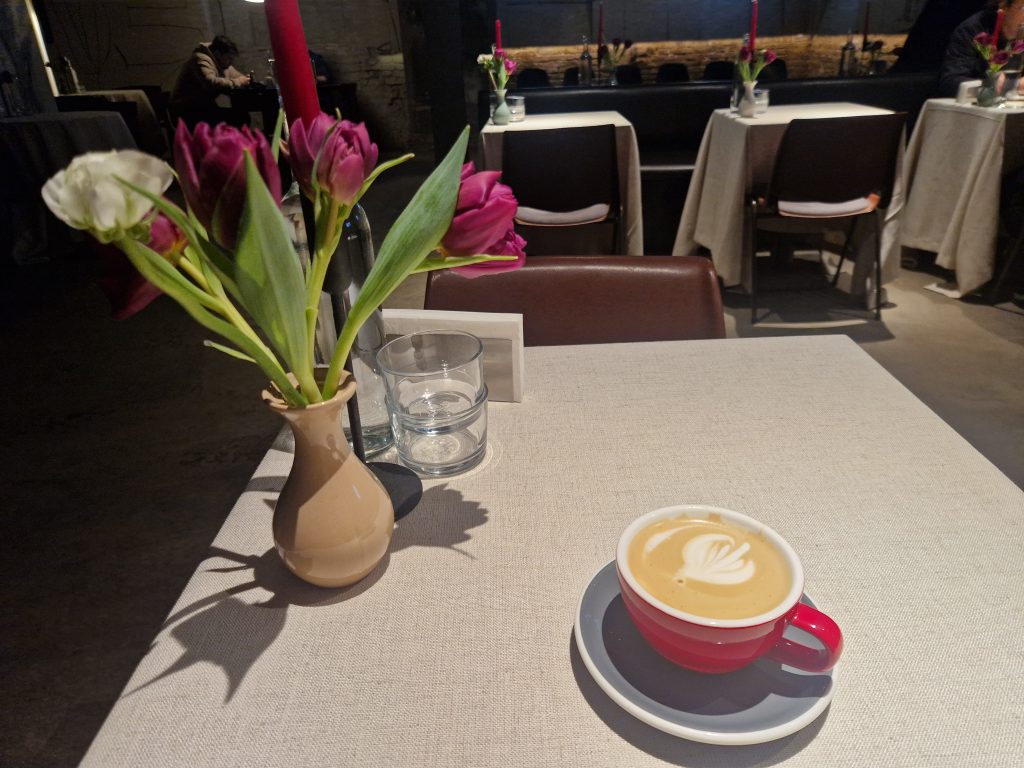
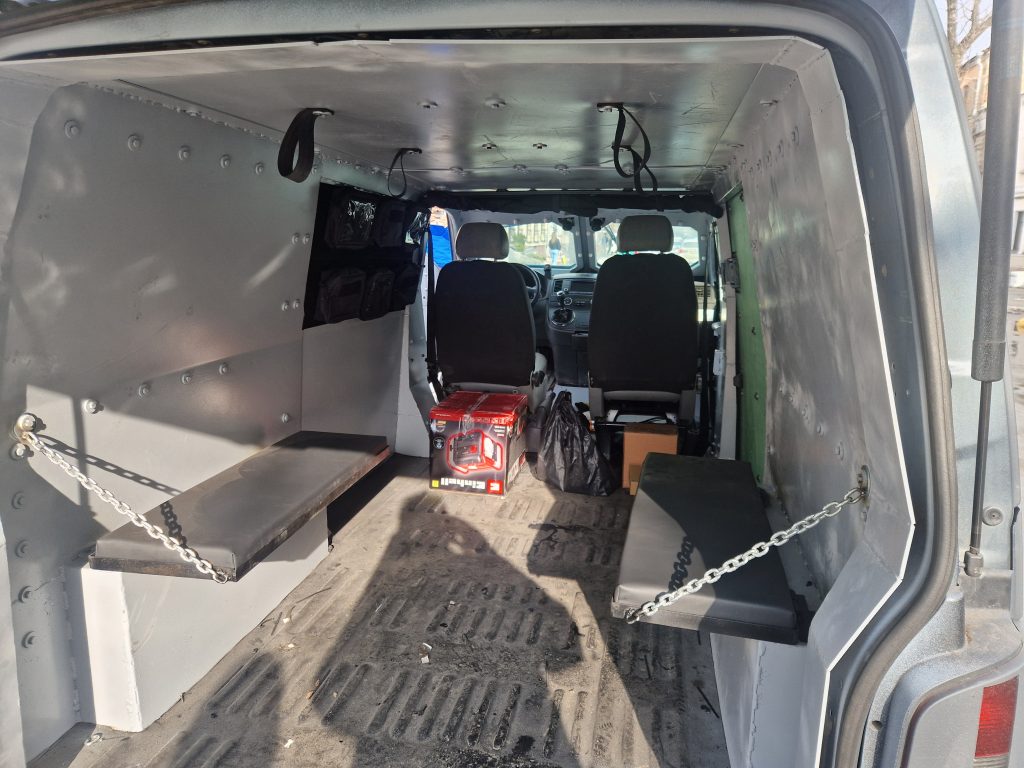
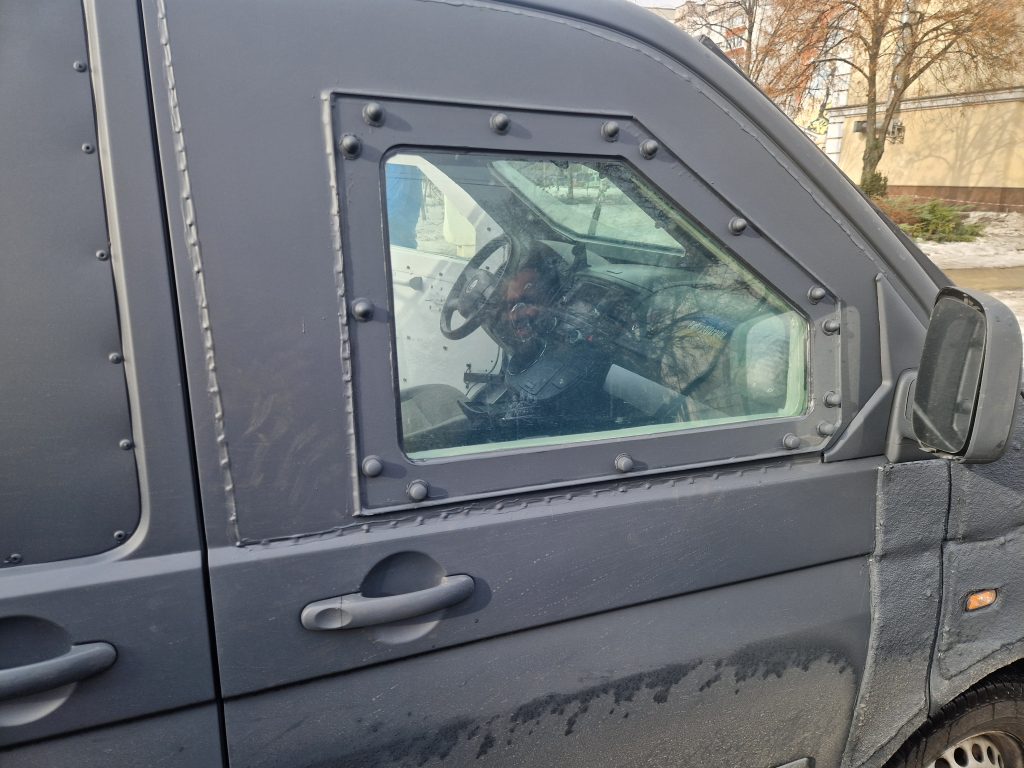
We push a few together so we can sit as a group. Afterwards, we walk to the Hub and hand over a few packages for a charity organization that one of our singers is connected with. Then we continue on to Nova Poshta. We unload the hospital supplies, and Niklas and Martin ride in the VW bus with Ruslan to the Bobrik Motor workshop. The VW T5 is being converted into an evacuation vehicle, and the two of them can talk to the mechanics on site. They learn that the lifespan of the so-called “Casevacs” (Casualty Evacuation Vehicles) is often limited, since they are specifically targeted by Russian drones, but each vehicle saves an average of 70 lives. We are very glad that we can contribute to this with our vehicles – with now over twenty Casevacs we have procured, that is a significant number.
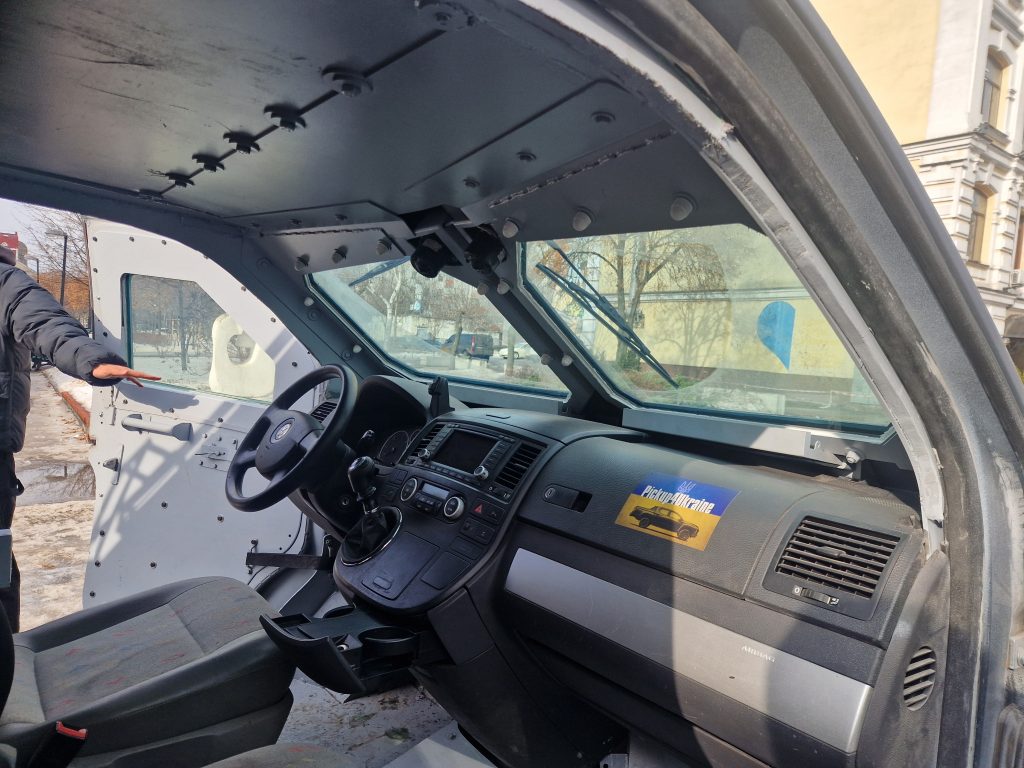
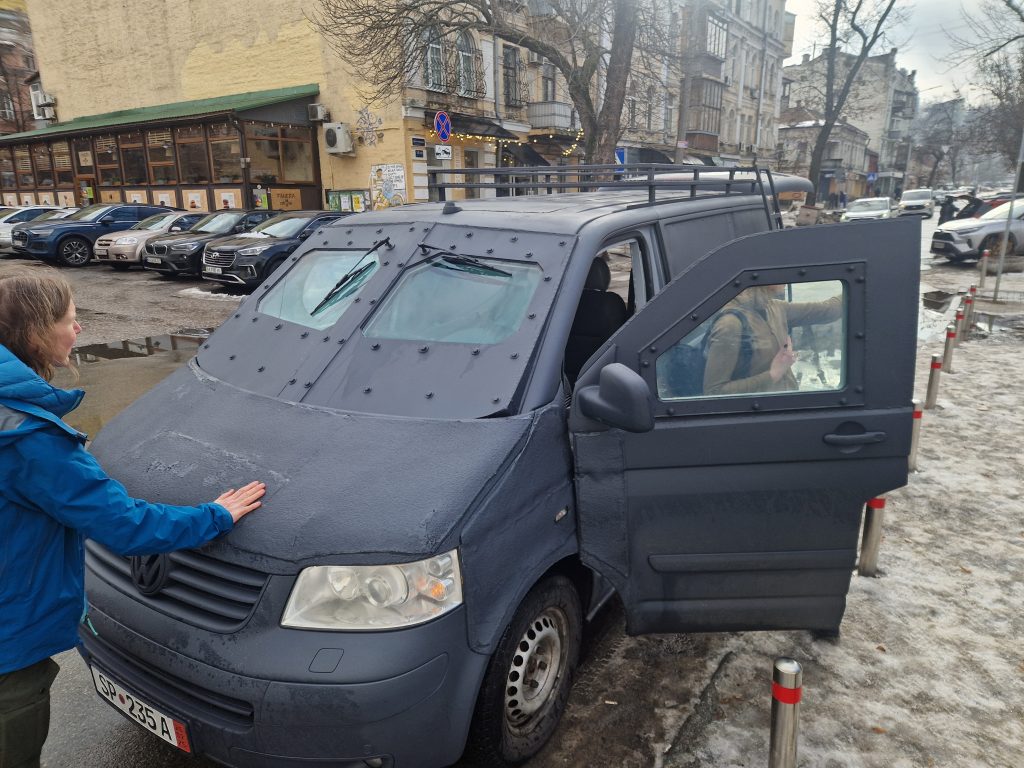
On the way back, Niklas and Martin are able to bring the VW T5 back to Kyiv with Ruslan, which we had first driven to L’viv last summer. Over the past few months, it was partially armored with steel, but also partially with lightweight material, and now it has been finished in Kyiv.
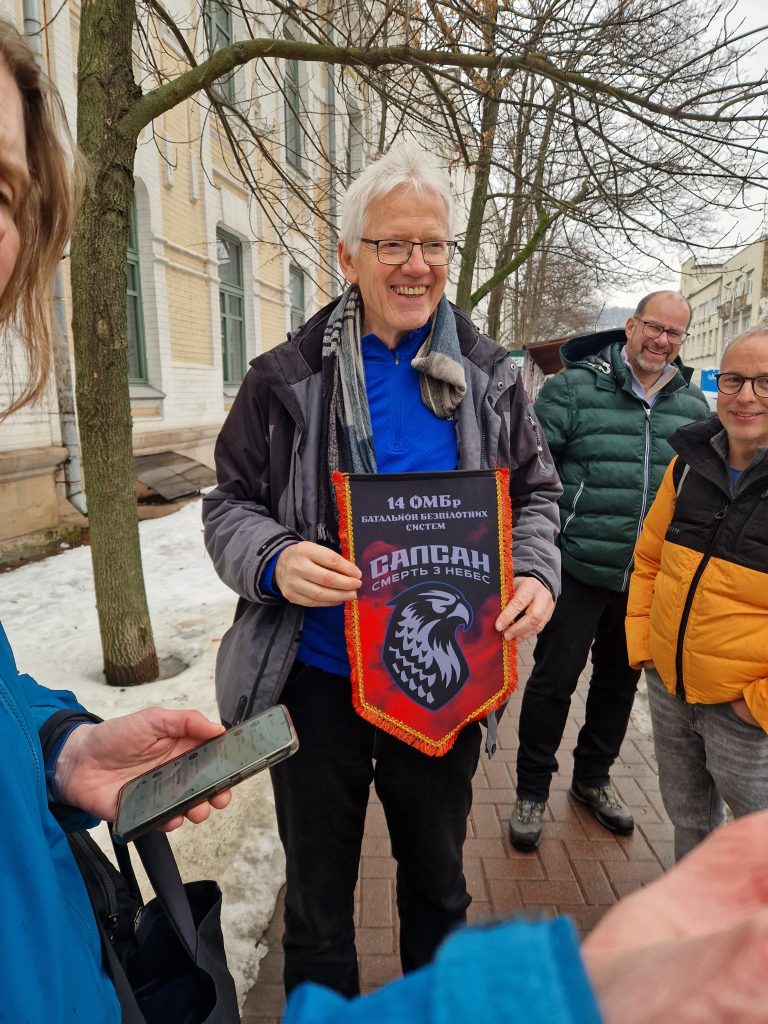
The other drivers and I stay at Nova Poshta and meet Mariia and Anja from Ukraine’s Frontline Hospitals there. They receive the boxes and bags and send them on their way to the hospitals, including in Kramatorsk. Afterwards, we drive back to the Hub. The recipients for the two pickups are already waiting there: A commander of the 14th Separate Mechanized Brigage “Sapsan” very matter-of-factly accepts the Ford Ranger and has the small quirks briefly explained to him. He and his team are in a hurry and leave immediately after the handover of the vehicle and documents—in exchange for a flag and patches. They have to get back to work. A representative for the 30th Separate Mechanized Brigade has also arrived, who is happy to take some photos of the handover with us, but cannot drive the car. He is waiting for a colleague. It’s raining, and we chat a bit. Then the colleague explains that he will be significantly delayed, so we head back to the hotel for now. As soon as we arrive, we get the message that the colleague has shown up, I run back to the Hub, we drive the pickup to the hotel, and they are allowed to join us for a coffee at the hotel. Nadia from our partner organization Lawyers’ Move joins us and can translate a bit. They “work” in the southeast, are both in their mid to late twenties, and are not professional soldiers. One was an engineer, the other a logistician. The one who was a bit late has a wife and child in Kyiv. He was able to see them briefly and becomes a bit quiet after telling us that. Shortly after, they too head back to the front. The work there is waiting.
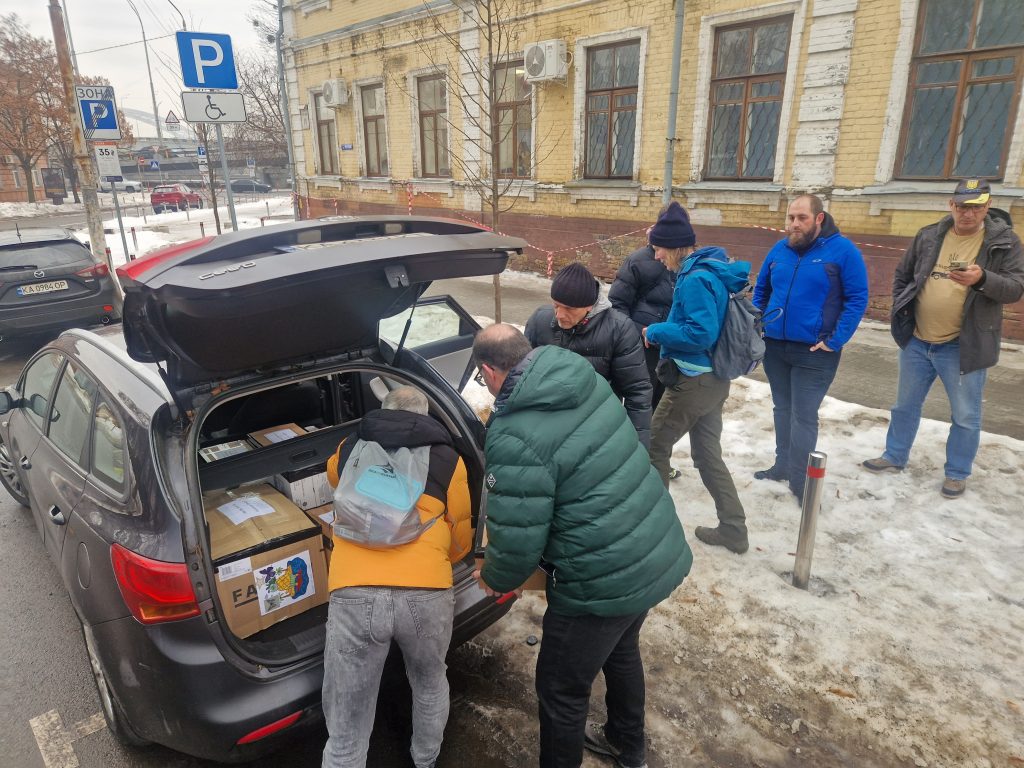
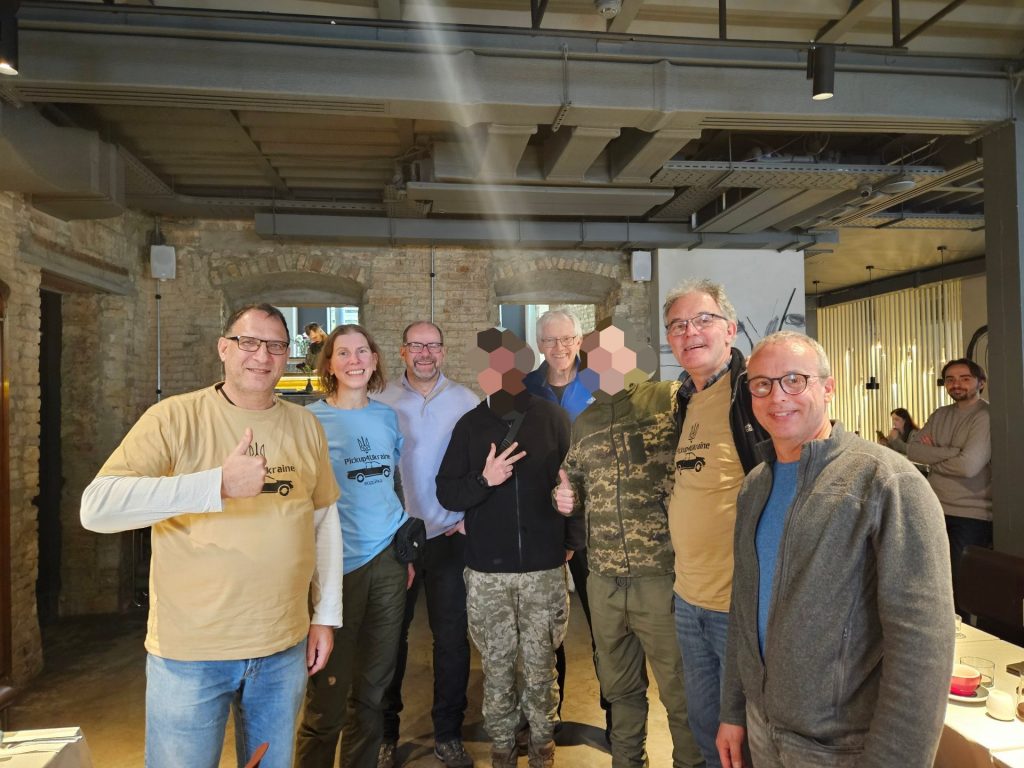
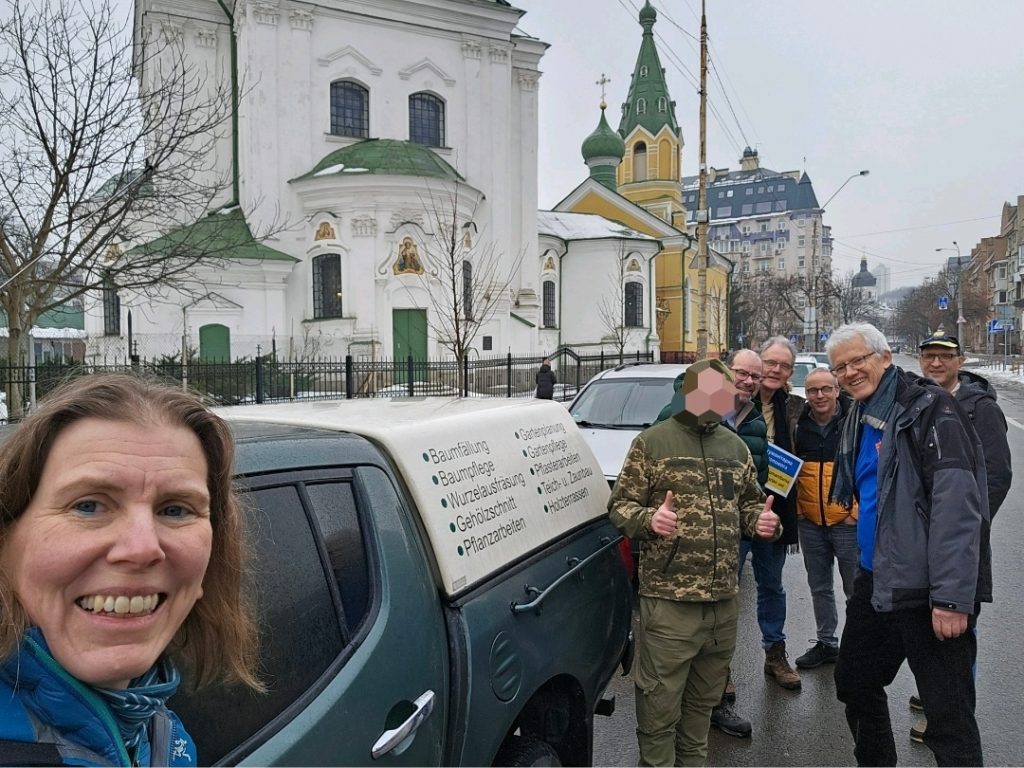
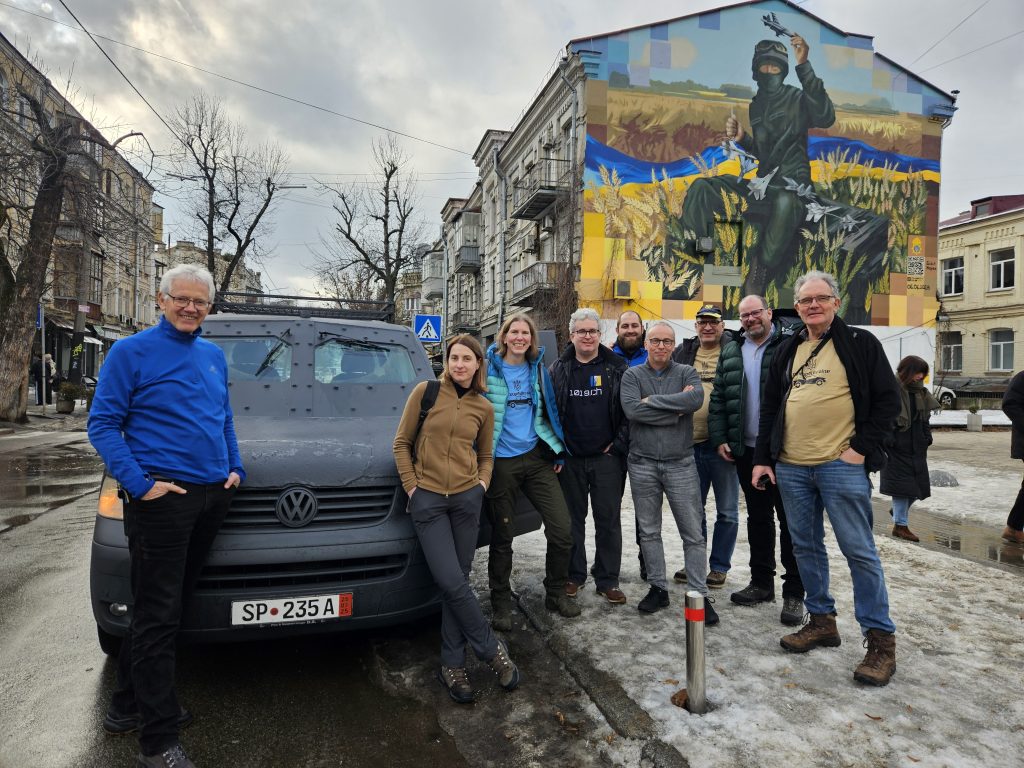
Martin, Niklas and Ruslan return from the workshop and have the armored VW bus with them. We go outside the door and Ruslan explains the special features again. The armored VW Bus is a prototype. The armor is light enough, so the 2.8l engine of the van still ensures sufficient acceleration and good driving behavior. It is intended to protect the occupants in the event of a possible drone attack, or even in the event that the vehicle hits a mine. The destruction of the vehicle is accepted. Procurement plus armor was expensive – but not as expensive as the purchase of a new, pre-armored vehicle. However, the amount for carrying out the conversion was clearly outside of the framework that Lawyers’ Move would otherwise finance. Ruslan explains to us the calculations, including the assumed value of any human life that this vehicle can save. Accounting for war purposes. After a few photos, Ruslan drives off and brings the VW T5 to the tire change again before it is handed over to the receivers.
We cannot hand over the KIA on Saturday, because the recipient Iryna is late. She does not drive directly from the front to Kyiv, but still makes logistical detours that cost her time. Nadia then hands him over Sunday afternoon.
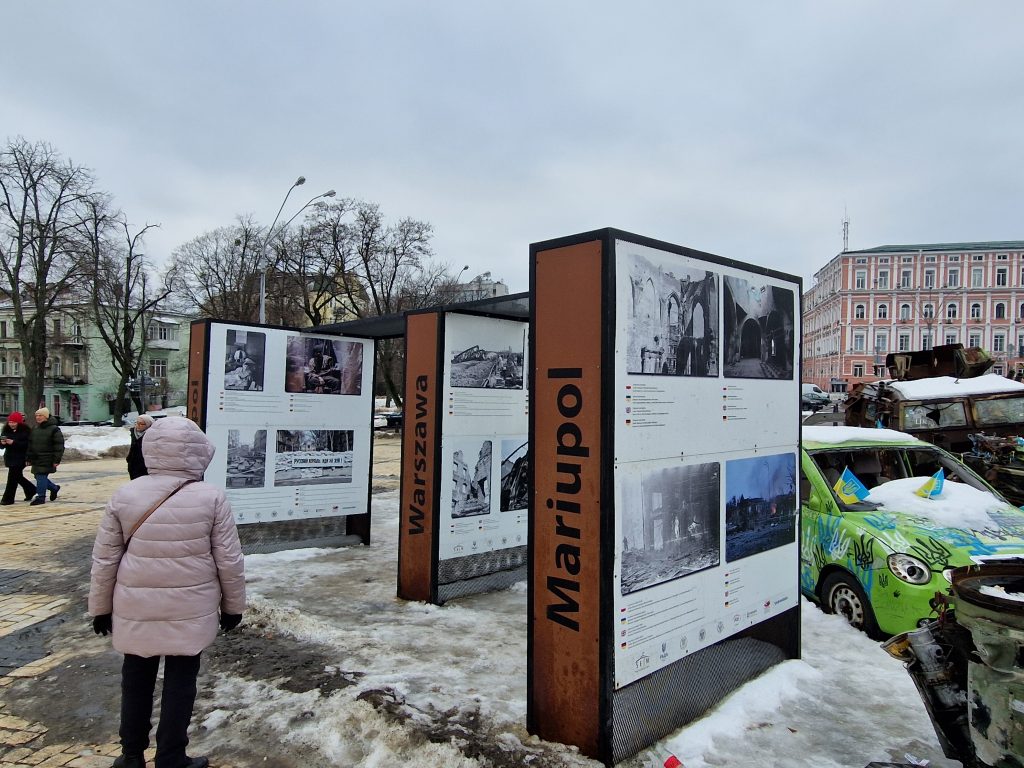
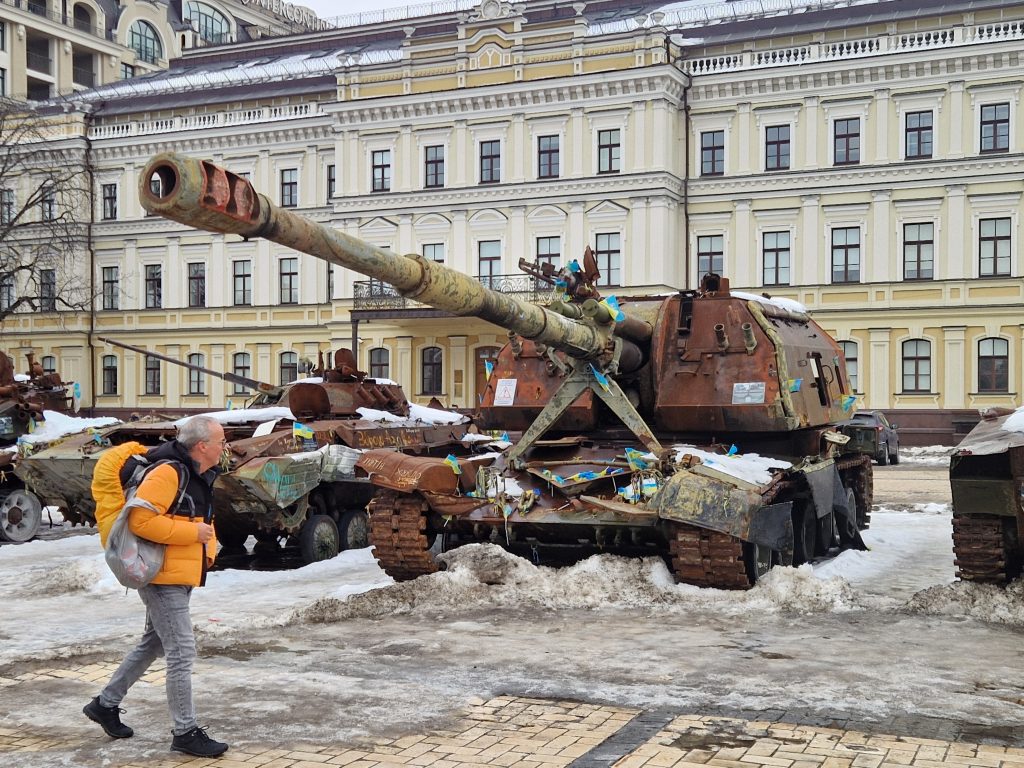
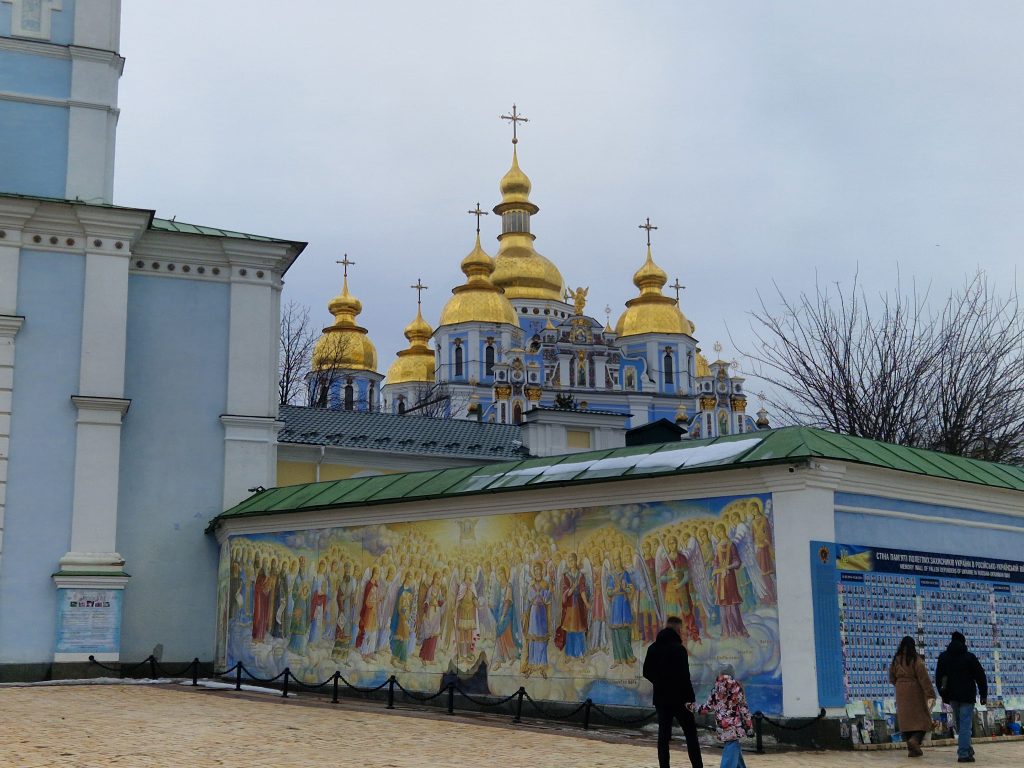
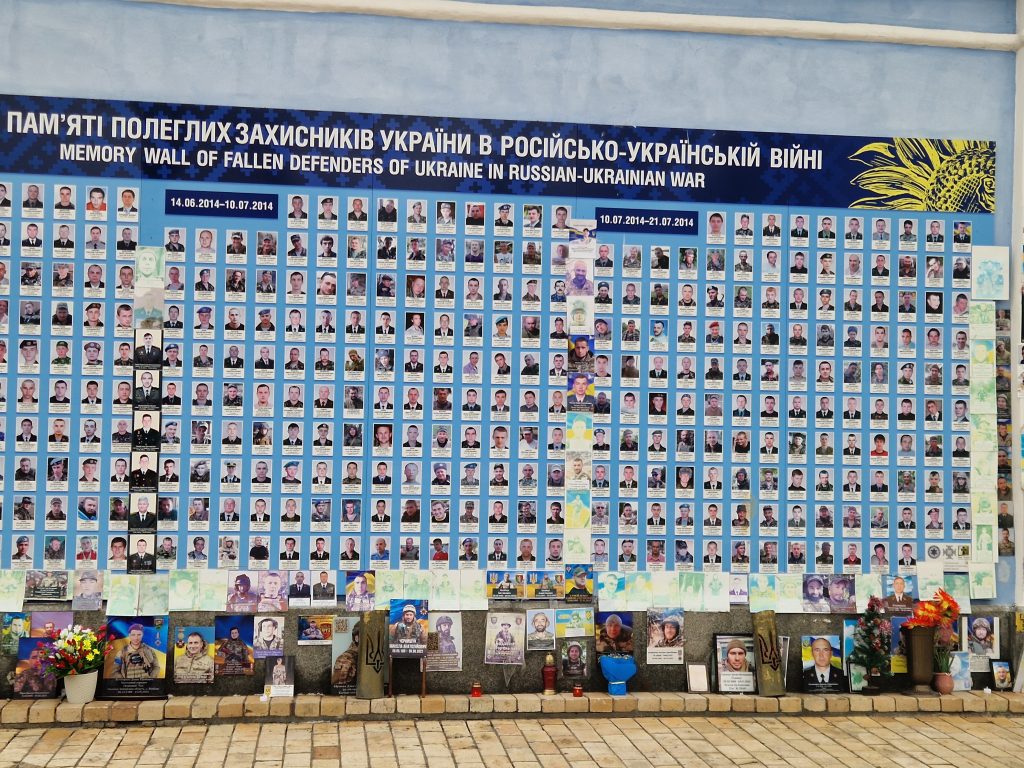
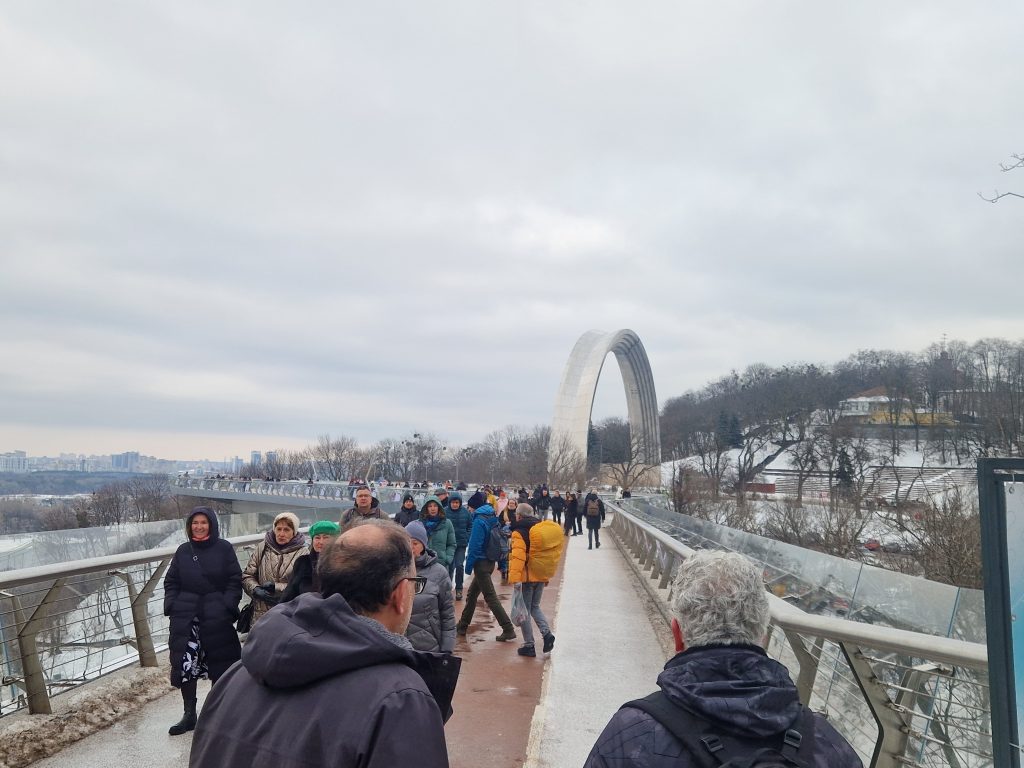
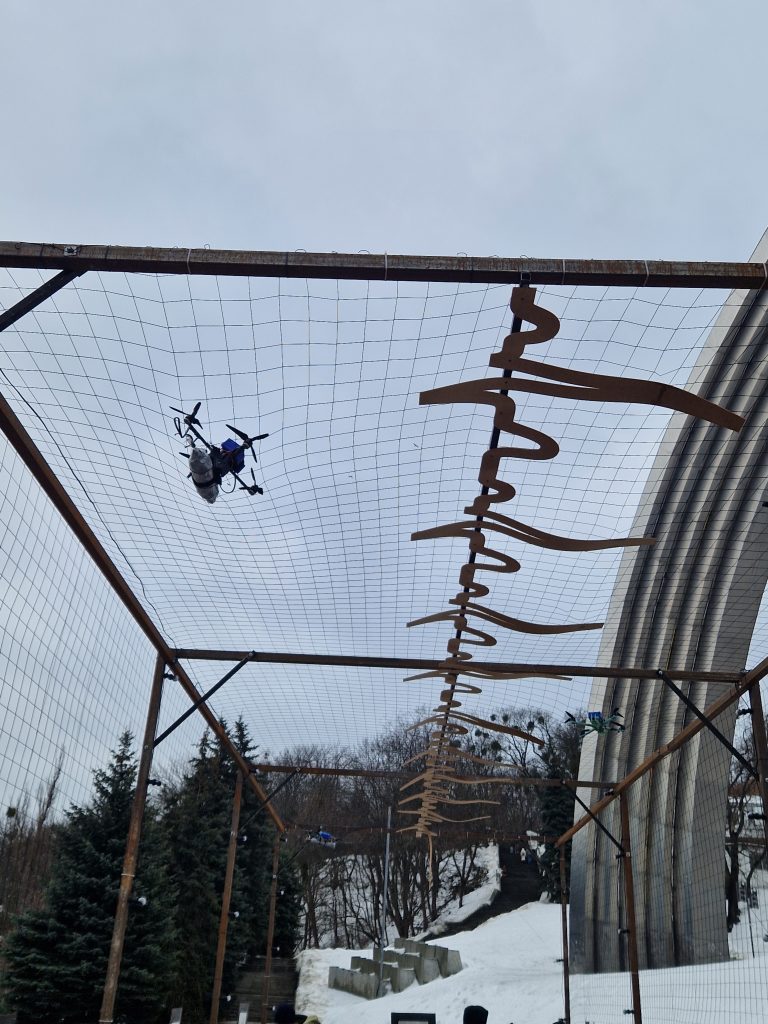
We made our way up to the city and first buy chocolate at L’viv Handmade Chocolates. The streets are cleared, the sidewalks sprinkled at least with split and sand. Some sections of the sidewalks are locked with red and white bands. There, ice plates keep falling down from the roofs in the milder weather. We walk up to St. Andreas Church, on to St. Sophia Square and finally to the square in front of the St.Michael’s Monastery, on which destroyed vehicles – since shortly after the start of the full invasion – are exhibited. The picture exhibition, which compares images of Mariupol’s destruction with the situation of Warsaw in the Second World War, is also still there. Our path continues to the glass bridge and the monument of international friendship. We look down at the Dnipro. Here it flows. It is frozen in other places. Right next to the bridge, we see an impressive installation: A section of road with drone protection nets has been reconstructed, giving you an impression of how, in the south in cities like Kherson, logistics—and also the civilian population—are currently being protected from Russian kamikaze drones. We continue to Maidan Nezaleshnosti. The flag field is covered in snow. In some places, the small blue and yellow flags hardly look out of the snow. I realize that the longer and more relaxed approach at the drive to Kyiv makes me less sensitive than usual and helps me keep my composure at the sight.
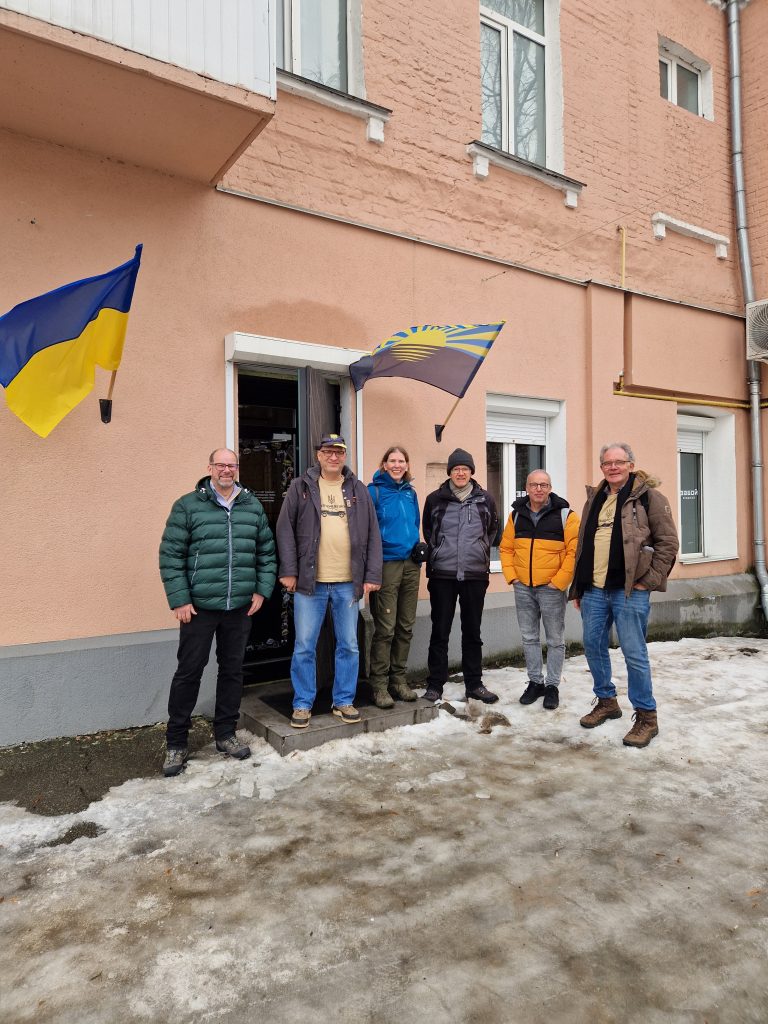
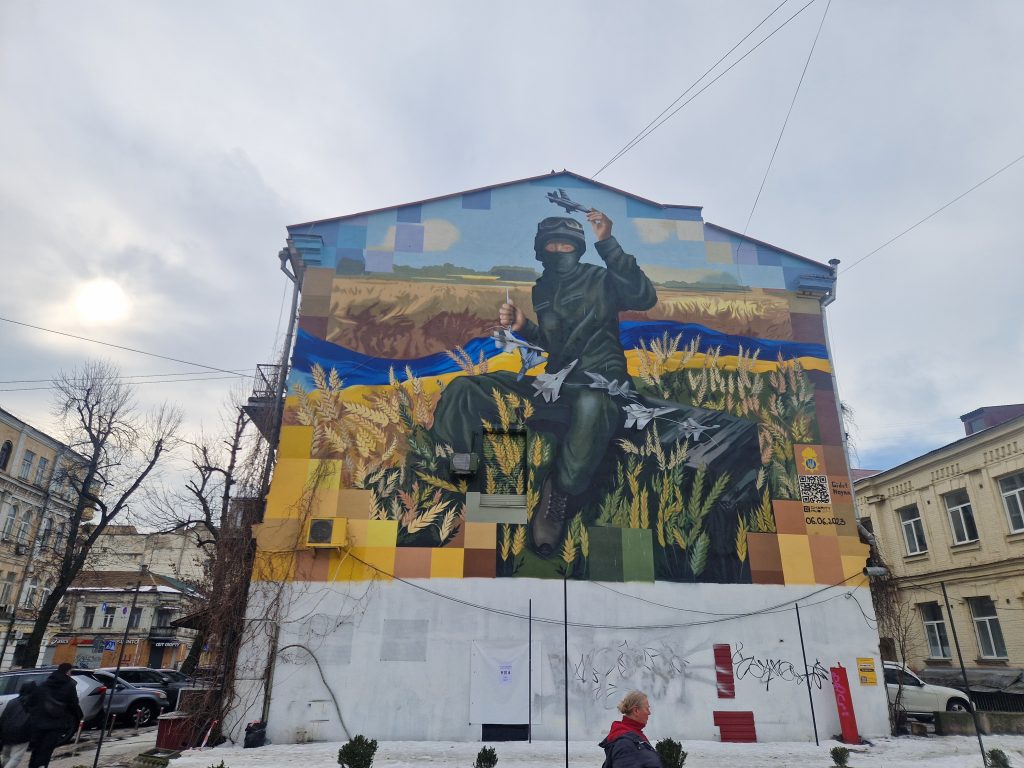
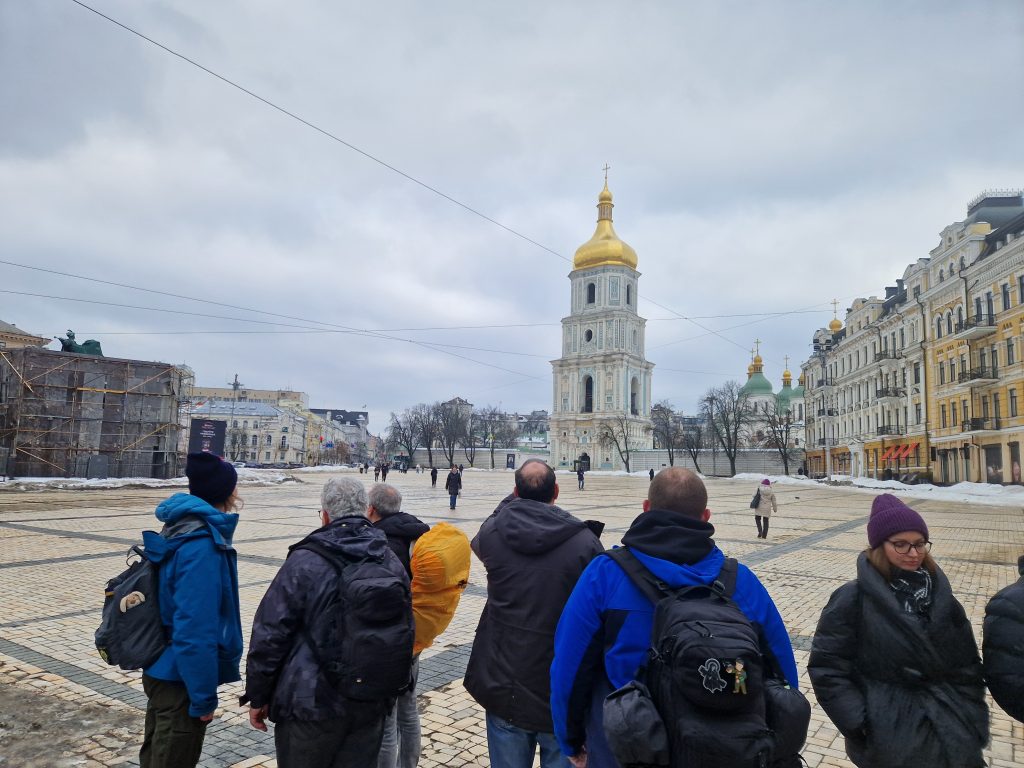
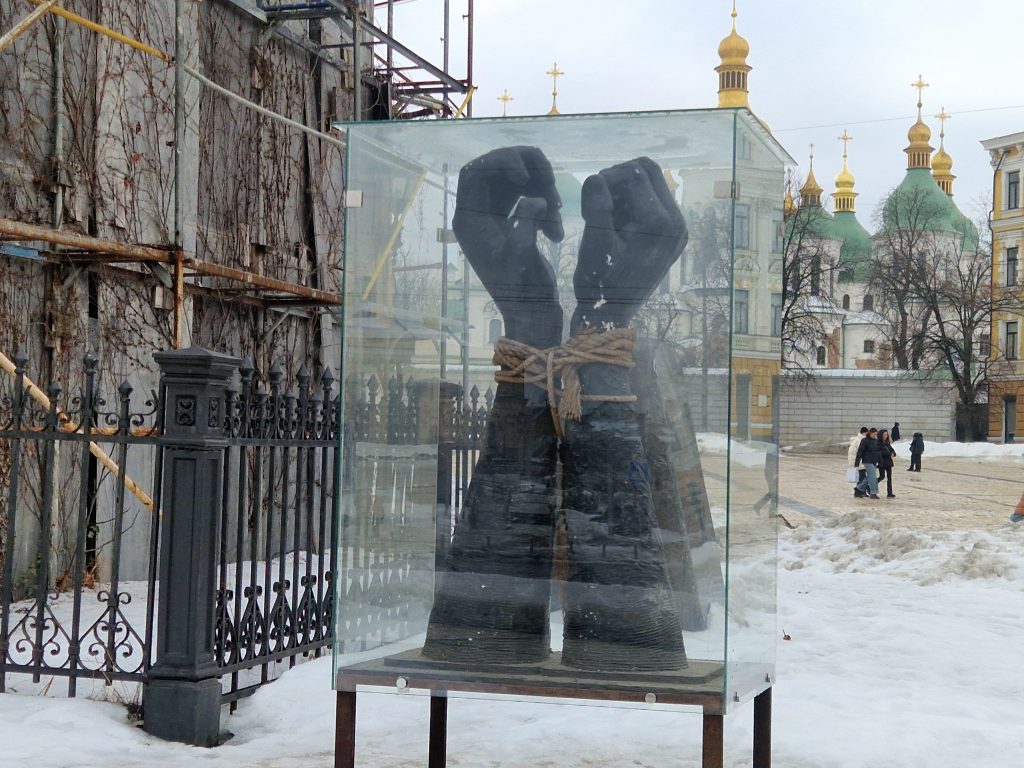
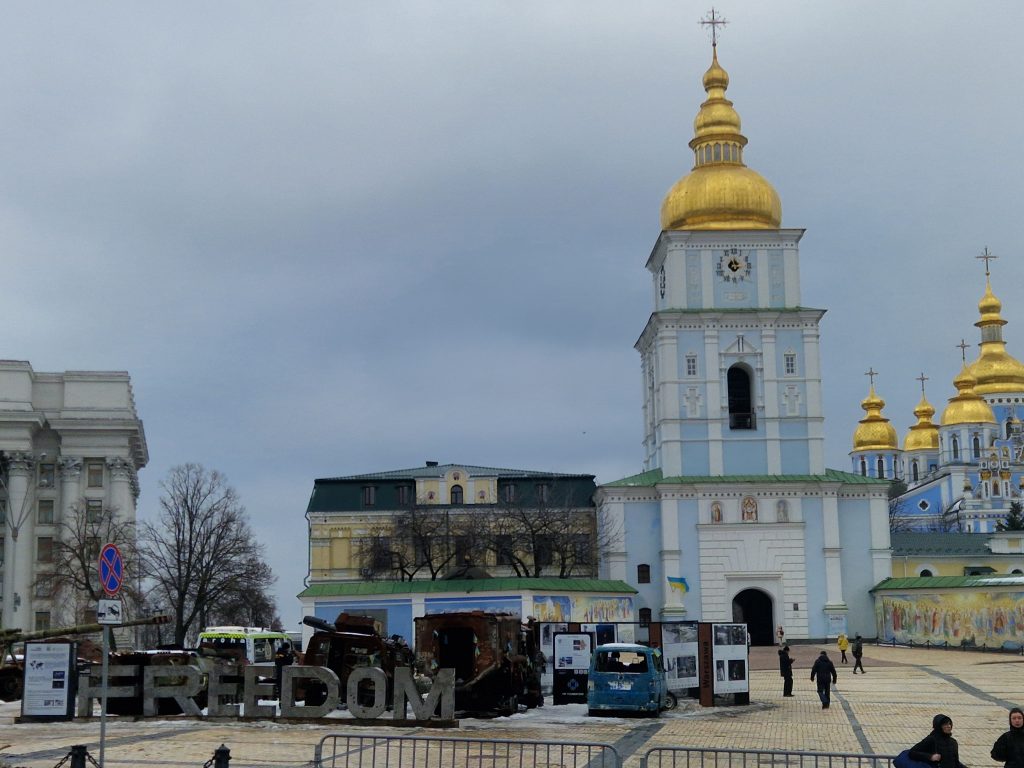
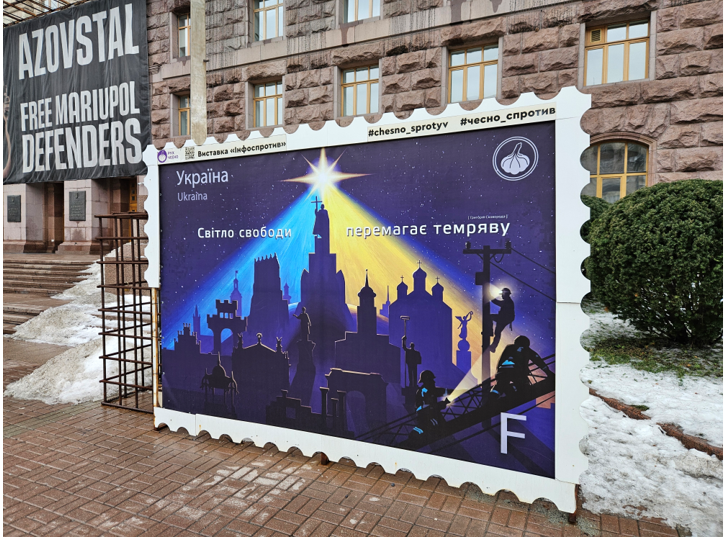
We walk to the town hall and admire the latest stamp on display in front of the building. Its heading reads “The light of victory overcomes the darkness” and the stamp is dedicated to those who repair and reconstruct again and again, after Russian attacks on the energy infrastructure.
Then our paths separate: Martin and Niklas are already making their way to the station, Heiko, Jürgen, Stefan, Stephan and I drink another coffee at the Sense café and bookstore. The café is well attended. We’re waiting for a while for a free table. I am thinking of Alena and her need to do pleasant things on purpose to better handle everyday horror.
Then Heiko also takes the metro to the station, and we return to the hotel. Malte spends the afternoon and evening with friends in Kyiv. We meet in the evening with Nadia and Ruslan in a scene pub with hundreds of beers. It’s loud, but very cool. Late in the evening we return to the hotel. We are allowed to spend this night in the warm hotel bed. Real luxury, followed by a warm shower in the morning. We are privileged.
Sonntag 15 February
We have a comfortable breakfast at the hotel, along with Nadia and Ruslan. Sasha and his wife Svitlana join. We hold intensive discussions on the situation in Ukraine, but also on the current policy in Europe, including the upcoming state elections in Germany and the elections in Hungary.
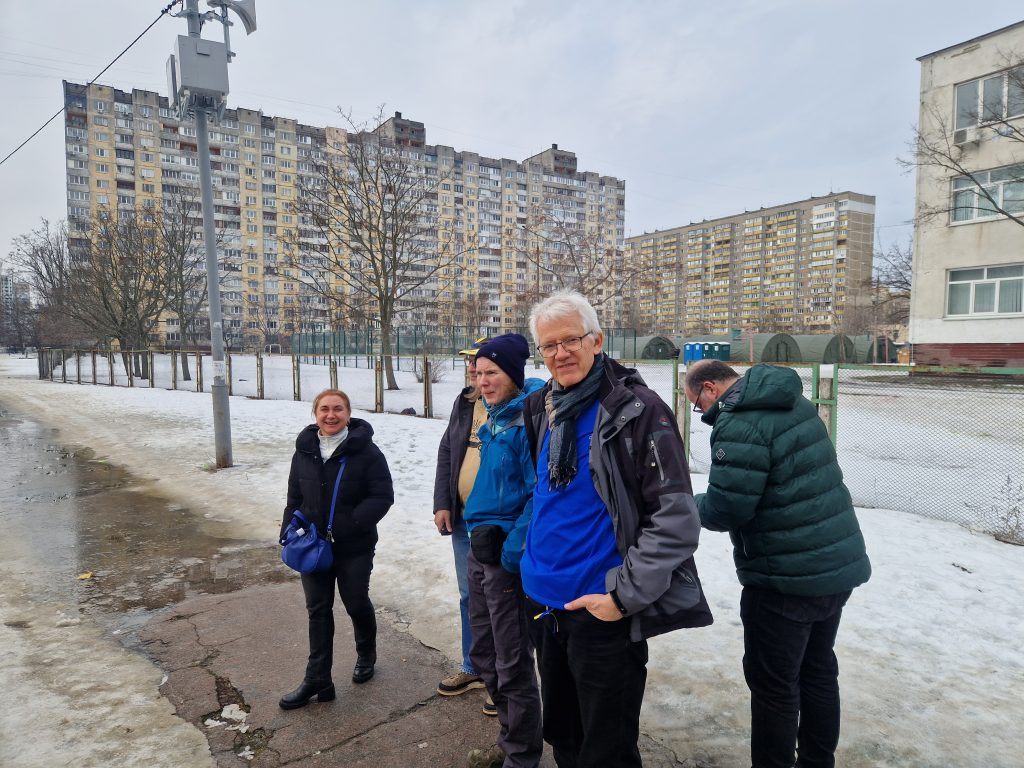
At 1100, Yuriy and Alena from SAP pick us up by minibus and we go to the left bank of the Dnipro. A museum visit is planned for Saturday afternoon and – as with previous trips – a dinner together before the return journey by train. Therefore, I wanted to spend the Sunday morning with something “sensible” from my point of view, so for example, help somewhere, clean away rubble, cook soup, make drone protection nets. Last October, we were able to give a little time to an aid organization in the Hub by helping to assemble IFAKs (soldiers’ first aid packages). This time, Anna, the director of SAP Ukraine, explains to me before the departure: “It’s good if you visit the people on the eastern Dnipro shore and look at how we help each other. You can then report on these experiences. And so we cross the river towards the east bank.
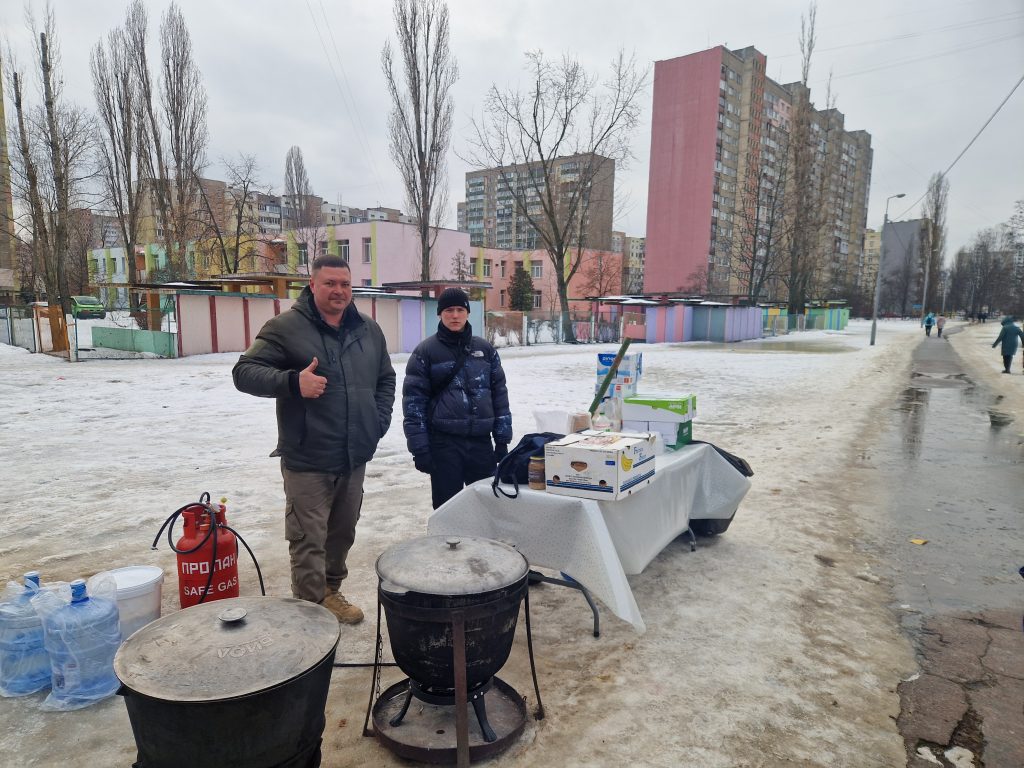
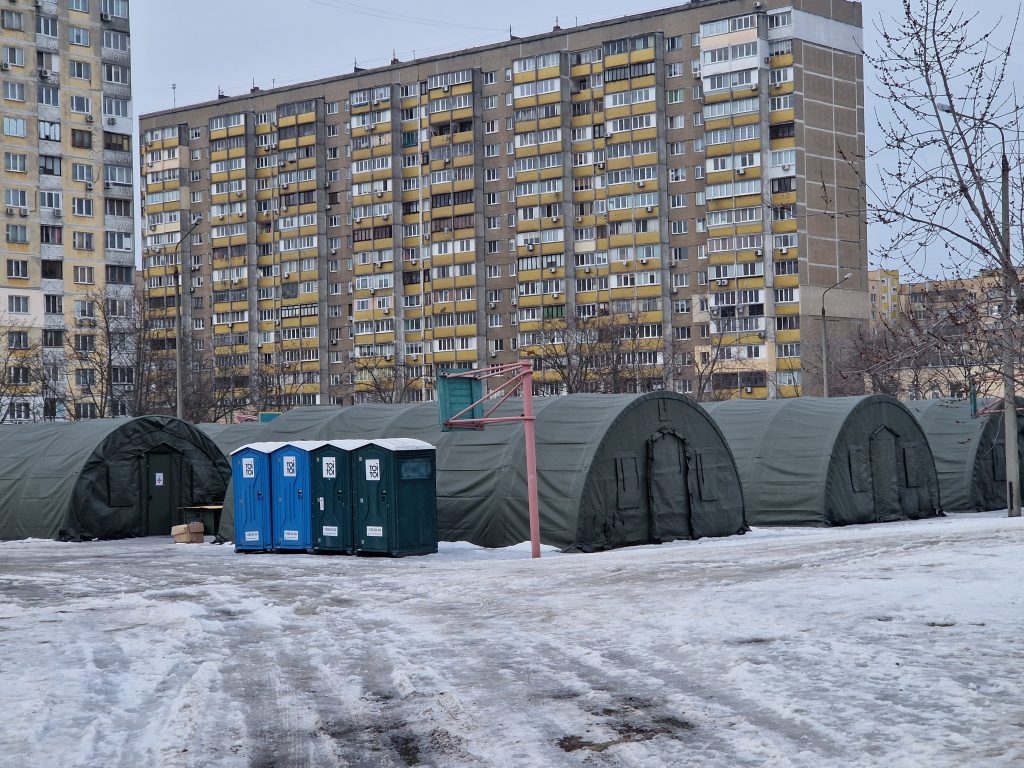
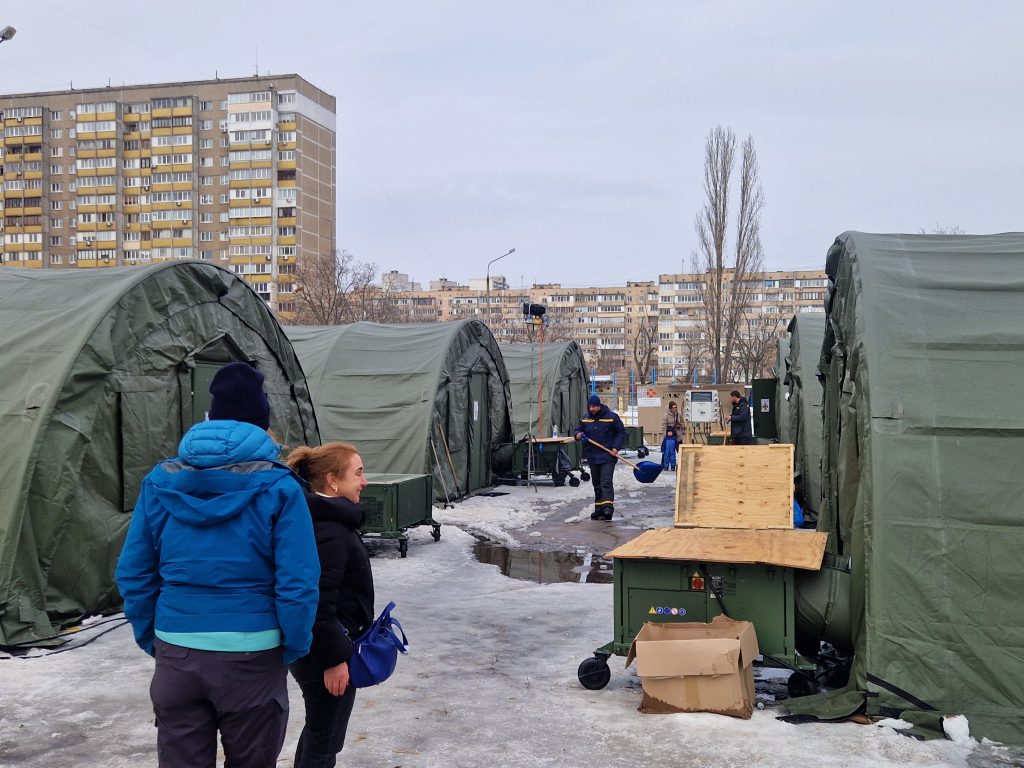
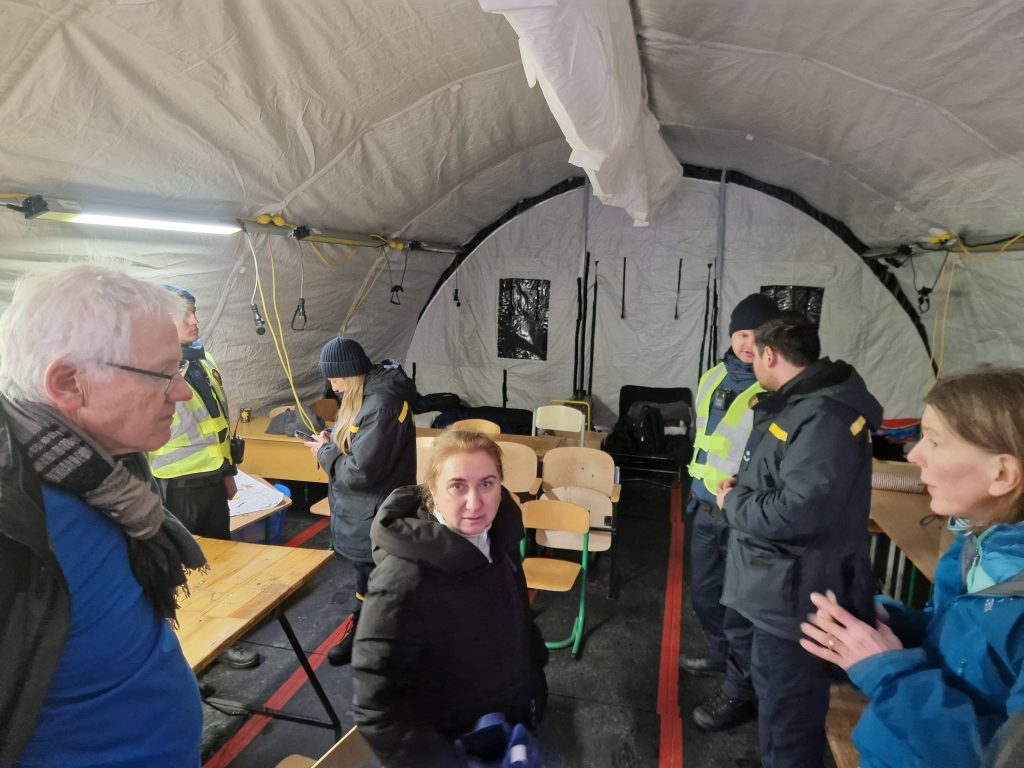
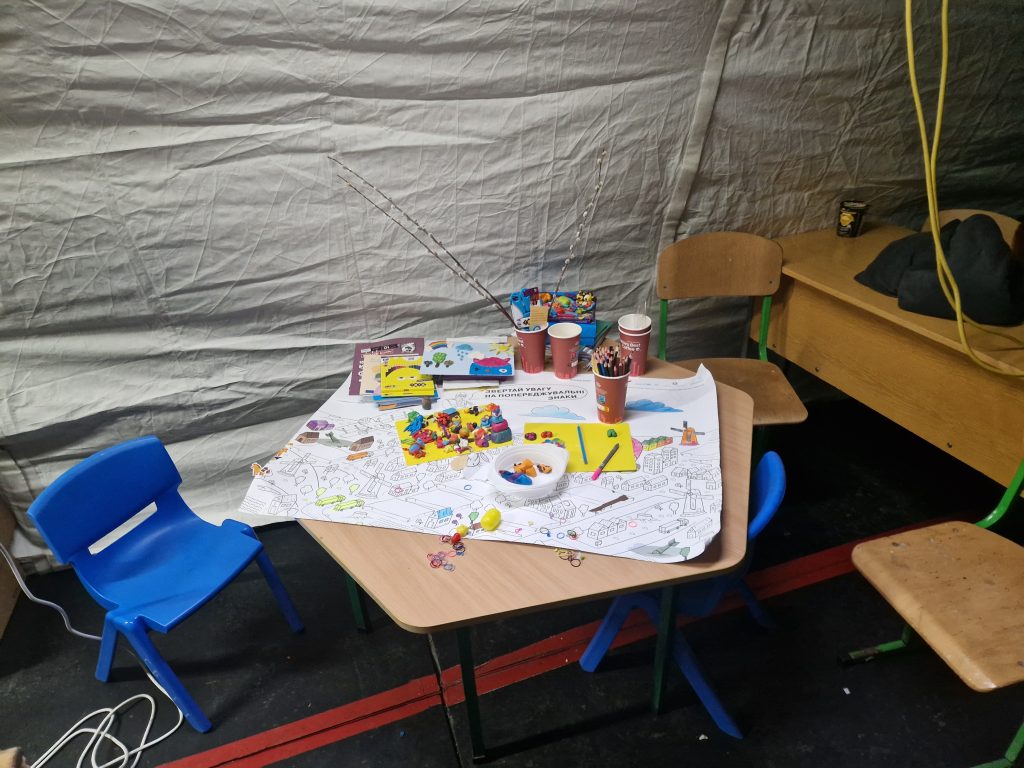
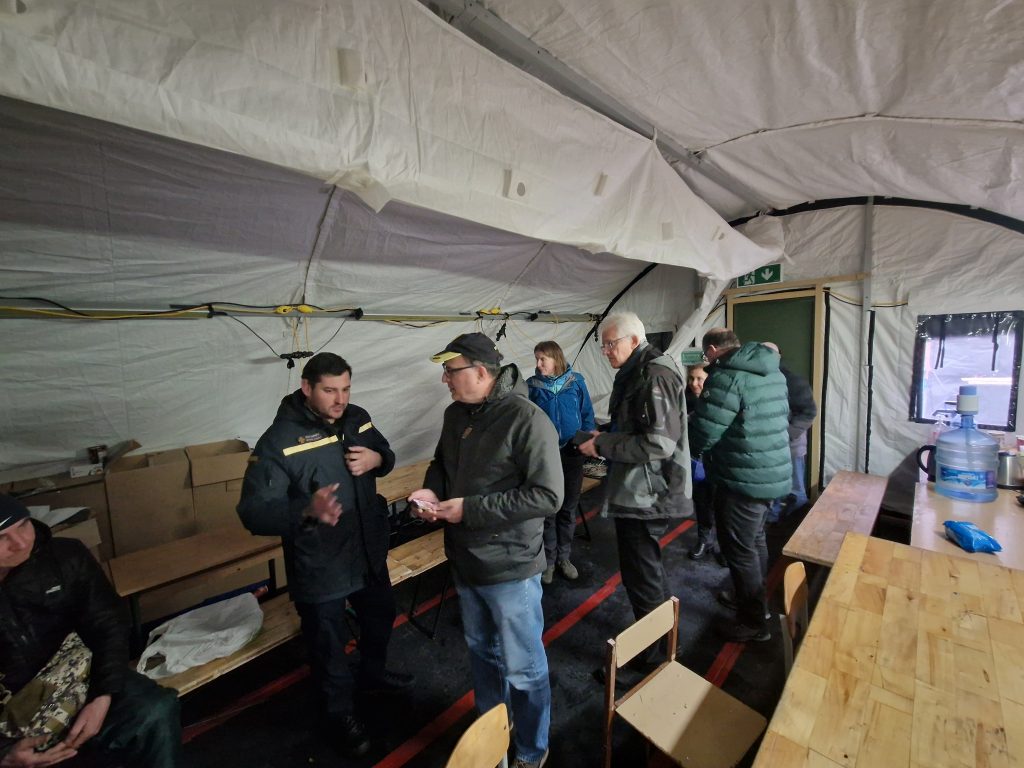
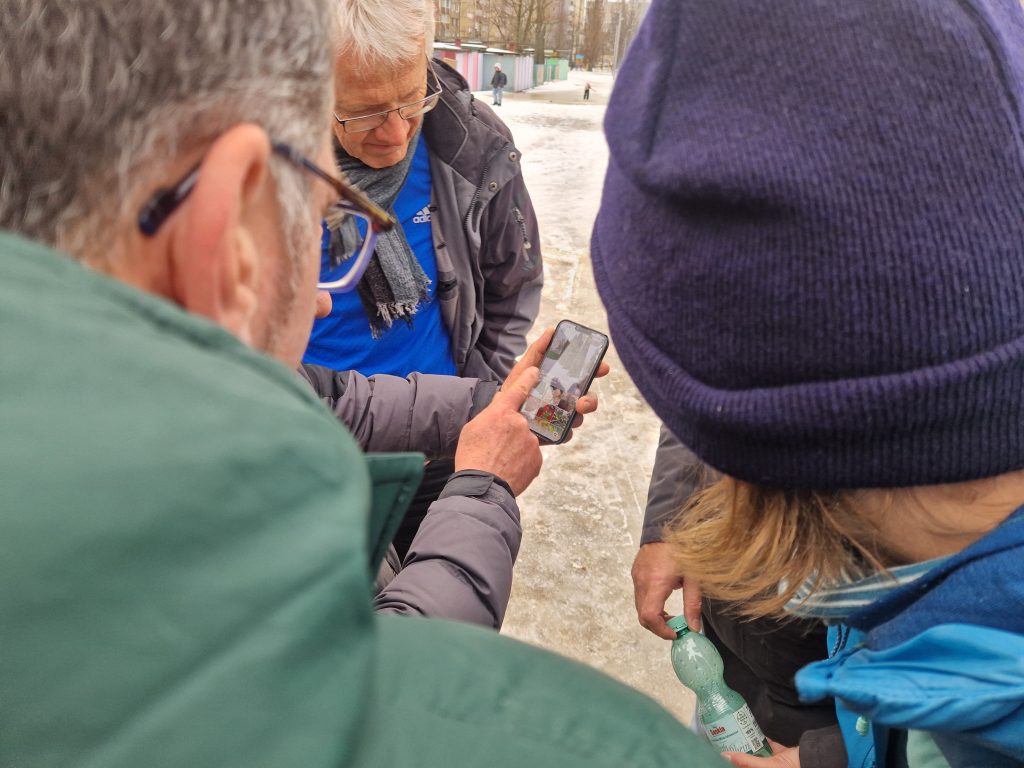
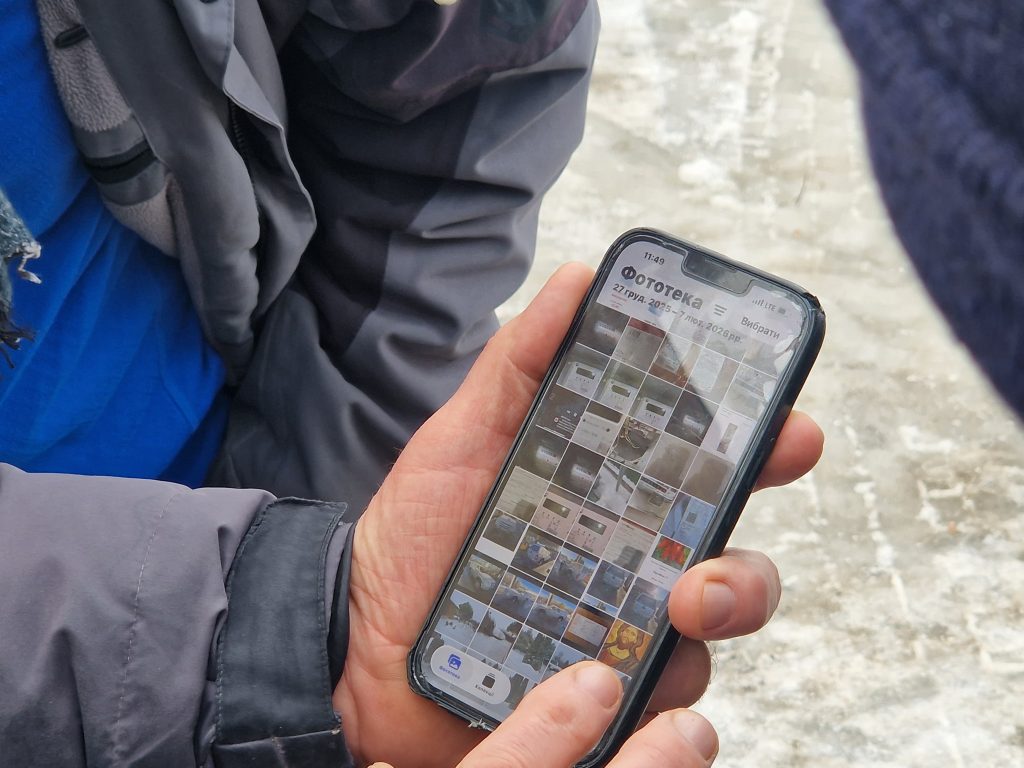
As we cross a frozen river arm on a bridge, we spot people on the ice standing by ice holes, apparently fishing. In the Kyiv district of Troyeshchyna, we park the van and get a glimpse into the lives of the residents who have been living for weeks without power in large apartment blocks. This morning, the temperature is still above freezing, and the ground is covered with ice, snow, and slush. In the courtyard of a large building complex, where several thousand people live, a relief organization has set up large tents that, with the help of generators, provide both electricity and heat for the people. Food can also be prepared there. As an alternative, there is also an improvised field kitchen outside with two huge kettles over wood fires, where borshch is currently being cooked. We talk with the people. The people organizing the tents are from Rivne. The supply situation there is not as severely affected as in Kyiv, so they are able to come here to help the local population. They have already been on site for several weeks. The people from the surrounding apartments keep coming to the tents to warm up, charge their phones, eat, drink, and get some sleep. In one corner, there is a low table with small chairs around it, with some toys, colored pencils and paper ready for the children. The soup cooks are from Mykolaiv. They are also volunteer helpers. As we set off again, they are just carving a paddle from a rowboat so that the raw wood is exposed. They then use it to stir the soup. Back at the bus, we ask Yuriy how he manages. He explains that he lives in a small house outside Kyiv and shows us pictures of his home and garden on his mobile phone. A little oasis of peace and beauty.
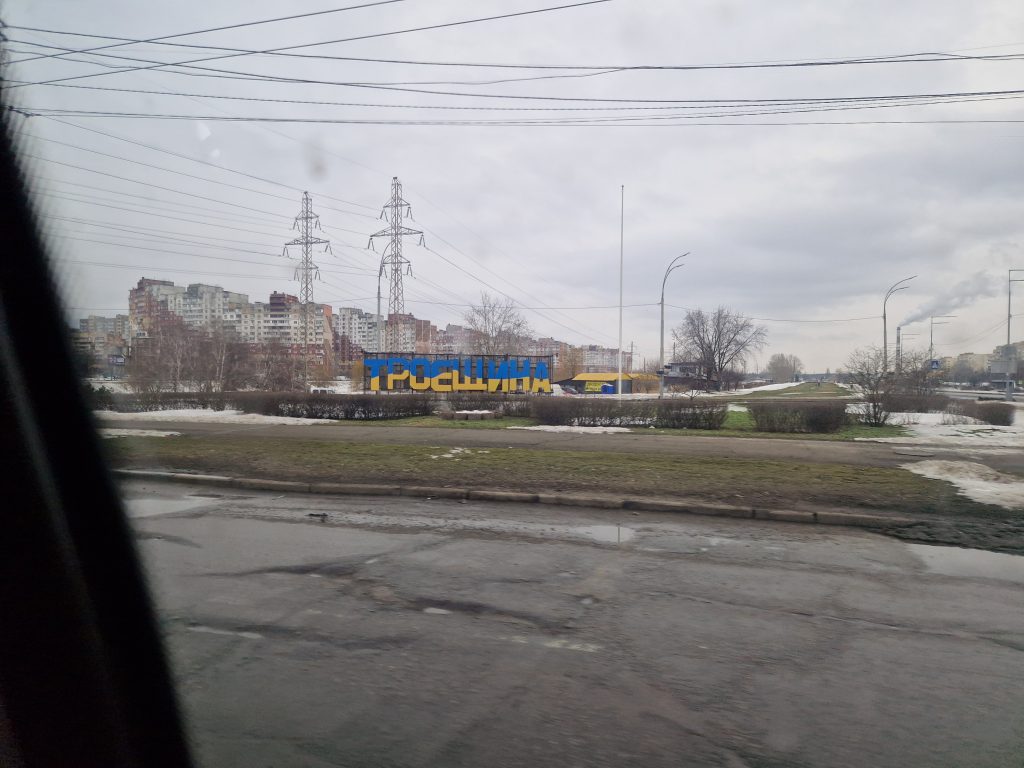
We continue to the district where Alena lives. She takes us to see two buildings that Russian drones have hit and partially destroyed. She saw the attacks from her apartment on 15th floor. There is no military infrastructure far and wide. A hospital is nearby, and a school. In the one of the attacked buildings, an apartment has been destroyed by the fire and the explosion made windows around have been destroyed by the explosion and replaced by plywood sheets. The family in the affected apartment could not escape the flames because they had sought refuge in the windowless bath.
In the other building you can see a huge gaping hole, whole parts of the apartment are missing on a floor and a half, only the supporting pillar in the corner is still standing and holding the apartments above it. The concrete pillar is kinked, but the steel reinforcement in the concrete still holds. Someone has – apparently out of sheer defiance – put up a pirate flag at the ruined building that flutters in the cold wind.
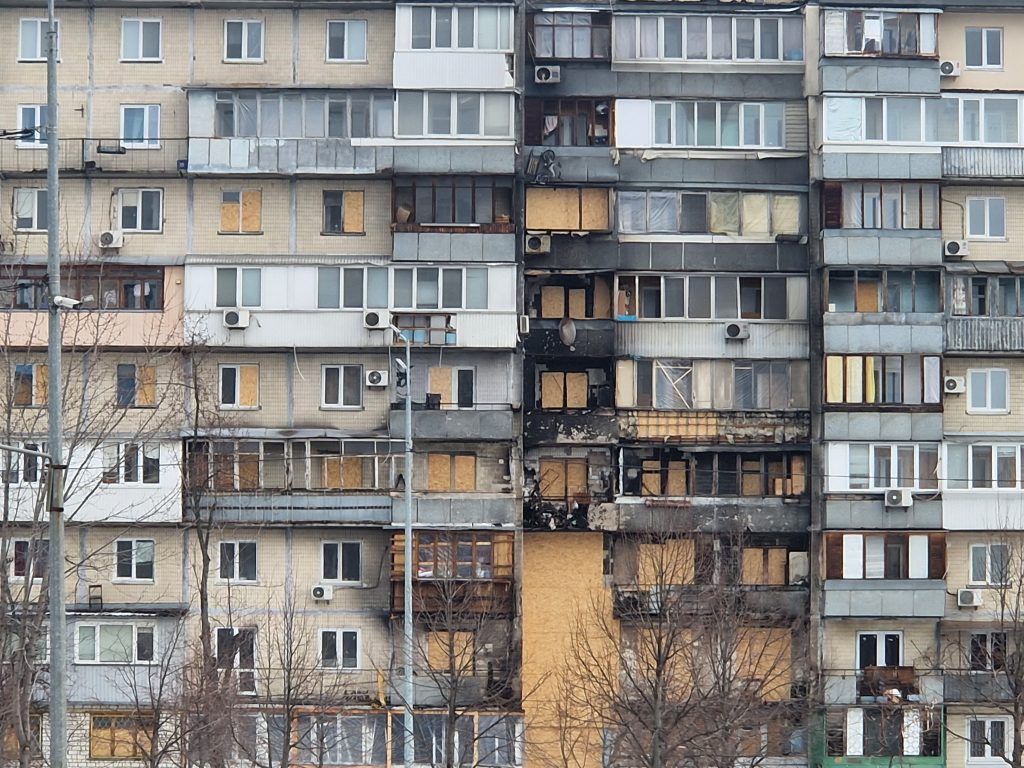
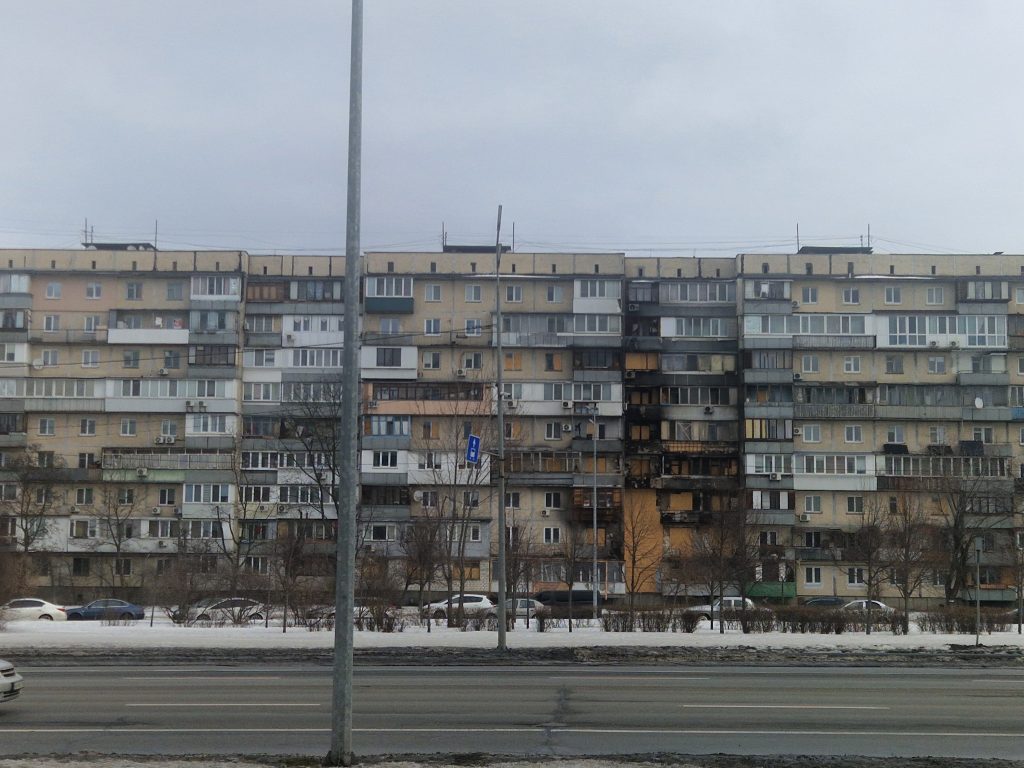
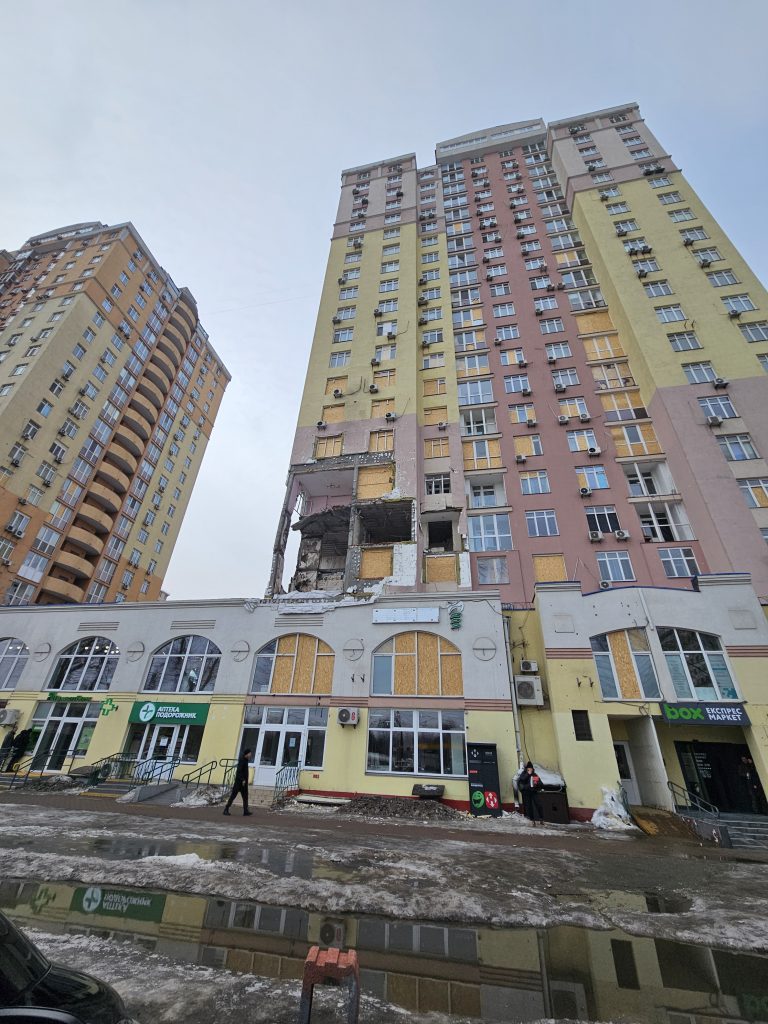
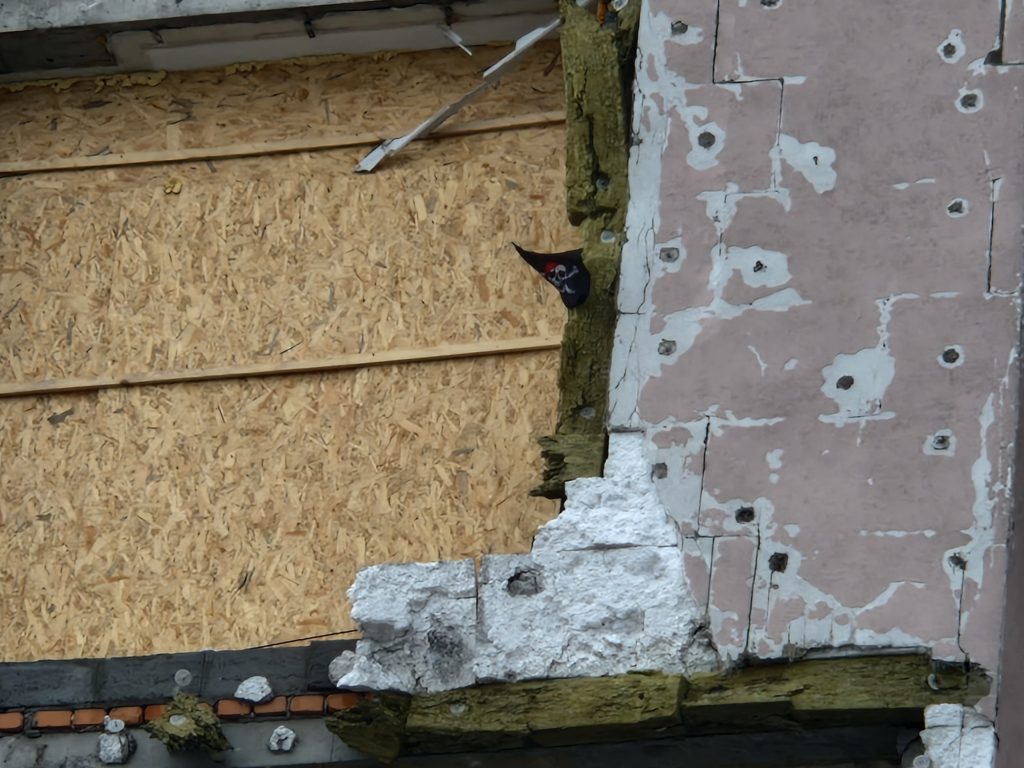
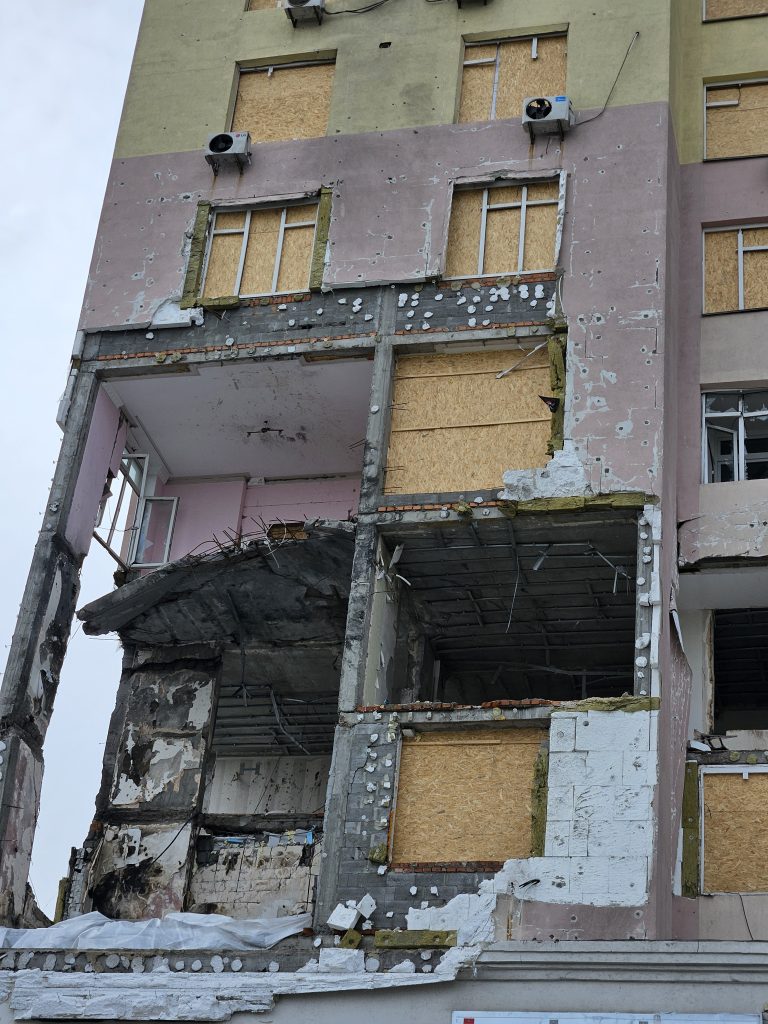
This is terror against the civilian population, as it takes place almost every night. Air defense has improved significantly again compared to last summer and now manages to destroy up to 90% of the nightly drones and missiles. But I celebrate every message that reports that Ukraine has succeeded in combating the real cause of the air strikes: Destroyed drone factories, airfields with bombers, and successful attacks by Ukrainian midrange weapons on Russian missile launch sites.
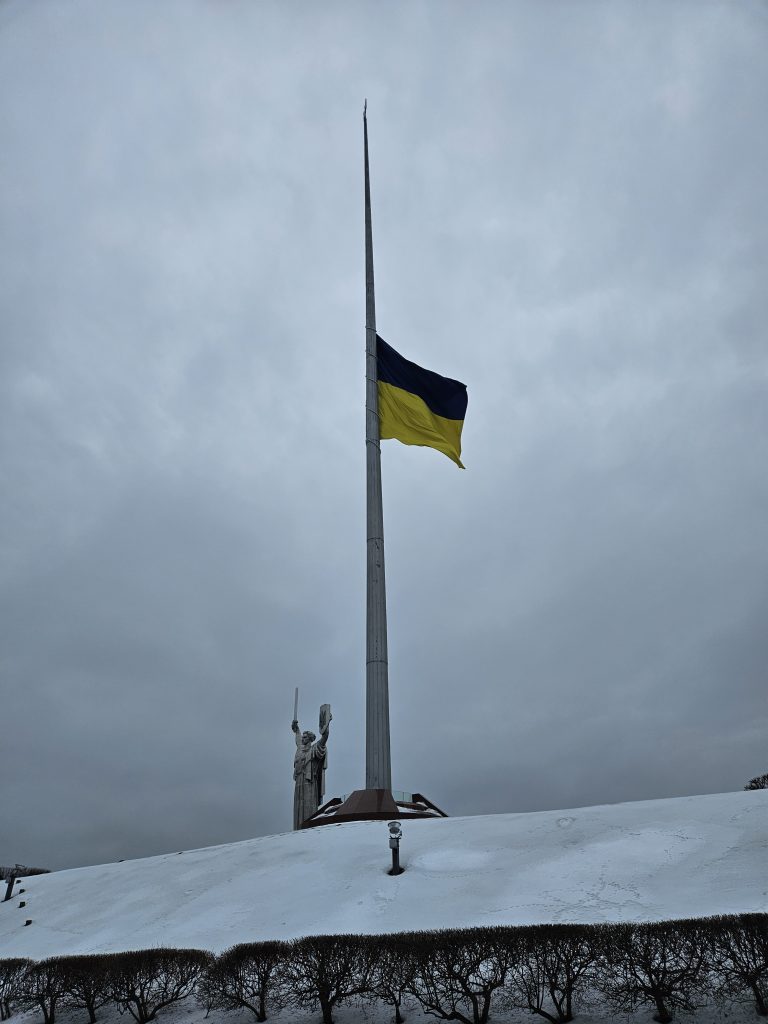
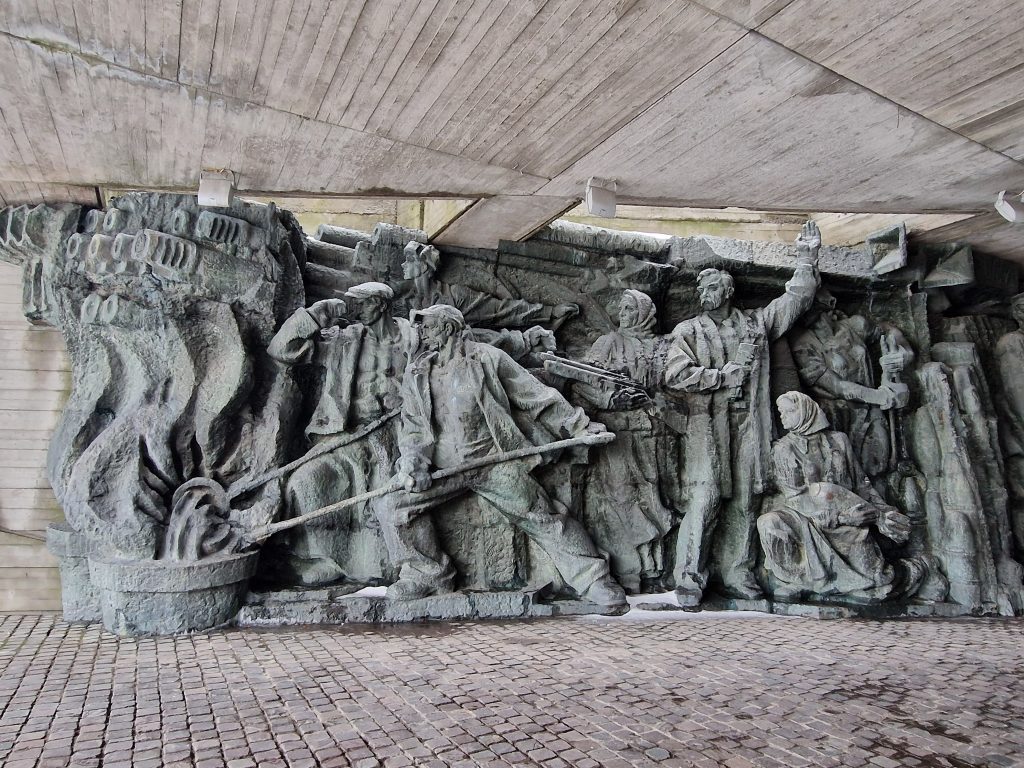
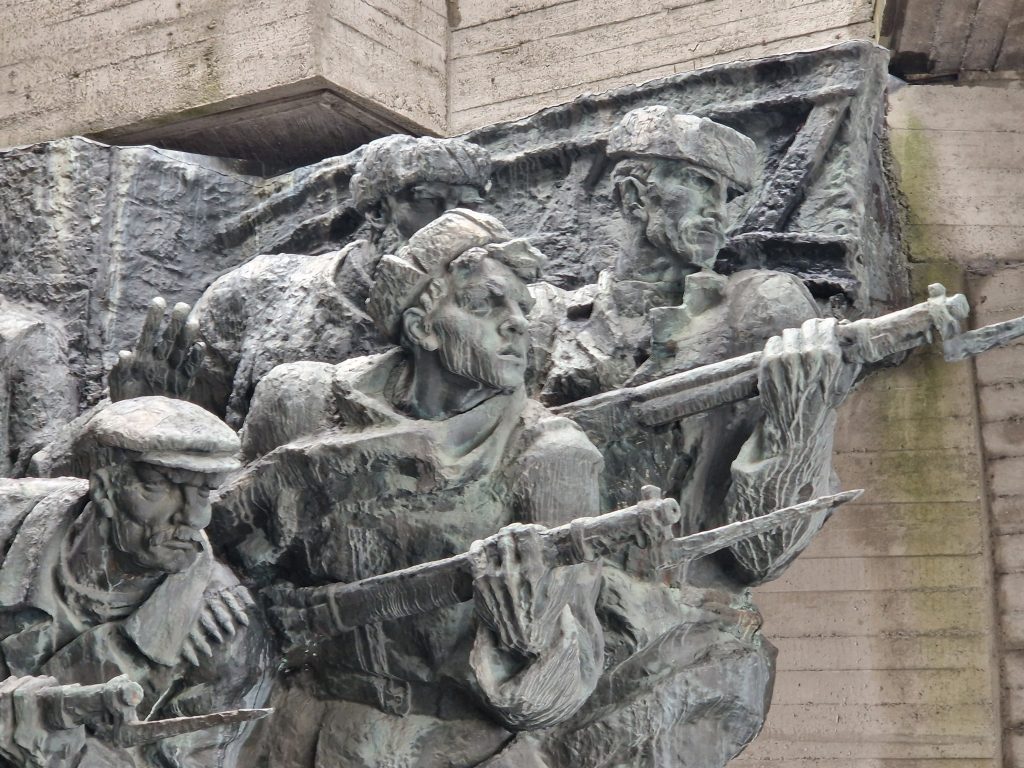
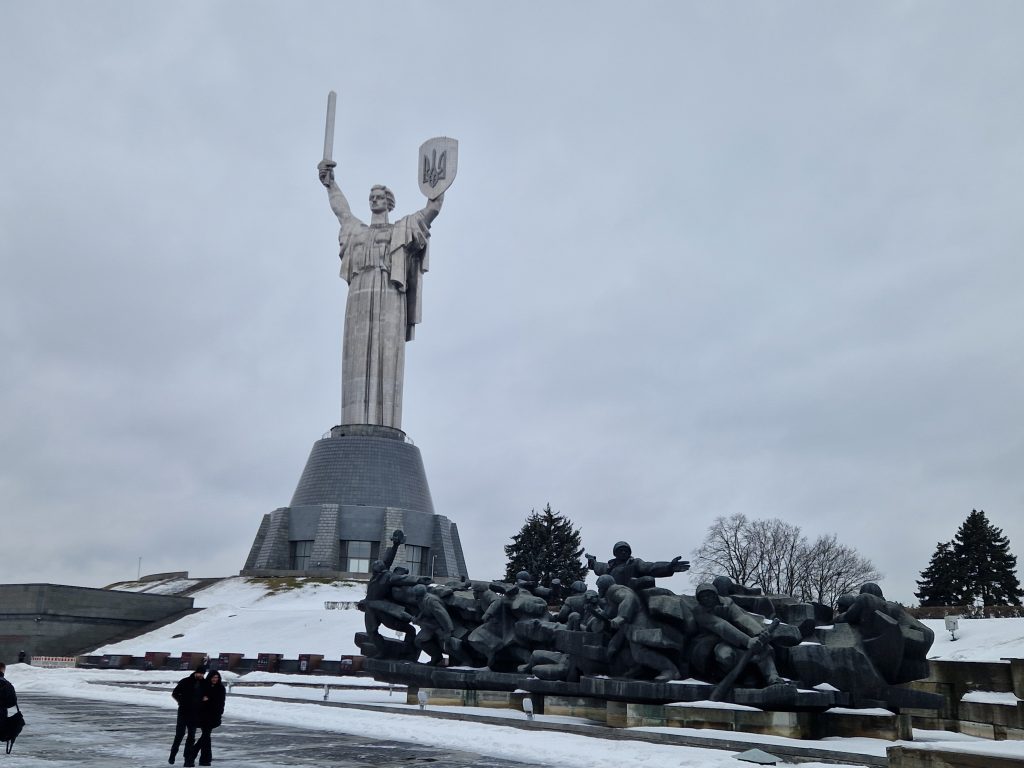
We return to the western side of the river and visit the area around the largest Ukrainian flag, which is permanently flown at half-mast, and the Motherland statue. On the shield that she holds up, the soviet hammer and sickle were replaced by the Ukrainian trident after the start of the full-scale invasion. The area itself was created in the 1980s. Dominating features are wall reliefs of determined female and male fighters in a brutalist Soviet style. Today, it seems somewhat out of place.
It has become noticeably colder and a light snow is falling. We go into the museum.
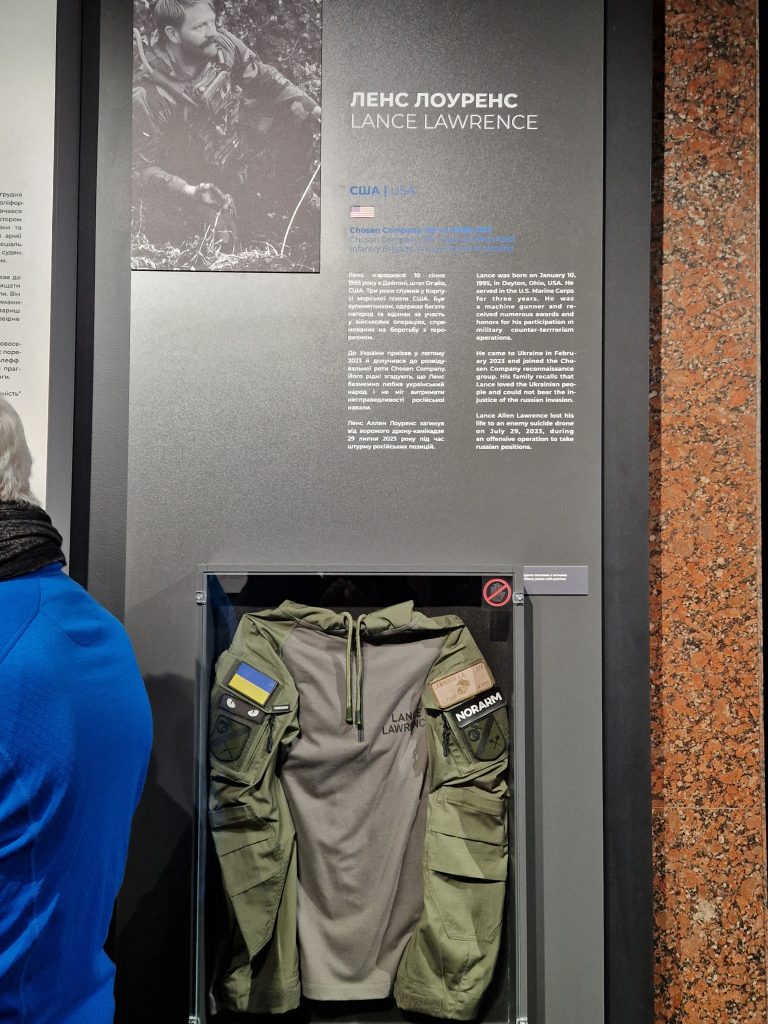
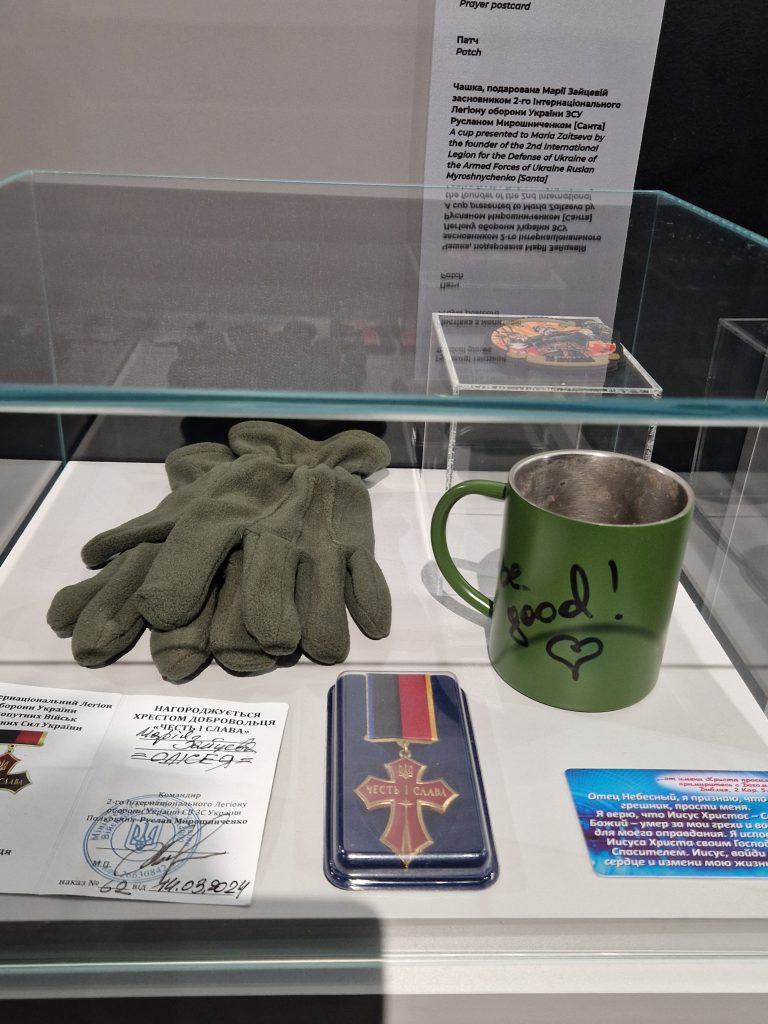
In the National Museum of the History of Ukraine in the Second World War, in the base of the statue, the collection on the ground floor has given way to an exhibition about foreign volunteers who have joined the Ukrainian armed forces. In a large semicircle, each station is dedicated to an individual person. The people depicted on the inside have already fallen, and their families have agreed to have their uniforms, as well as, for example, personal belongings or awards, displayed here. You learn something about their lives and their motivation. I am particularly moved by the preserved cell phone chat between a fighter and his father, shortly before the young man lost his life when, in the summer of 2024, a Russian missile hit a pizzeria in Kramatorsk.
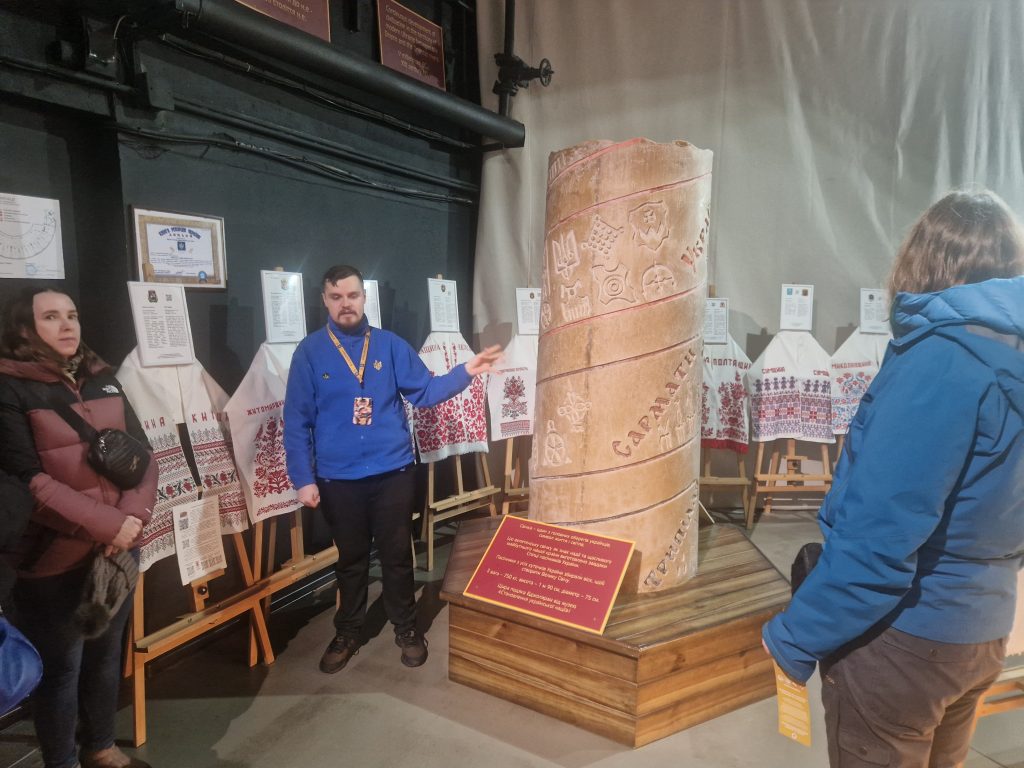
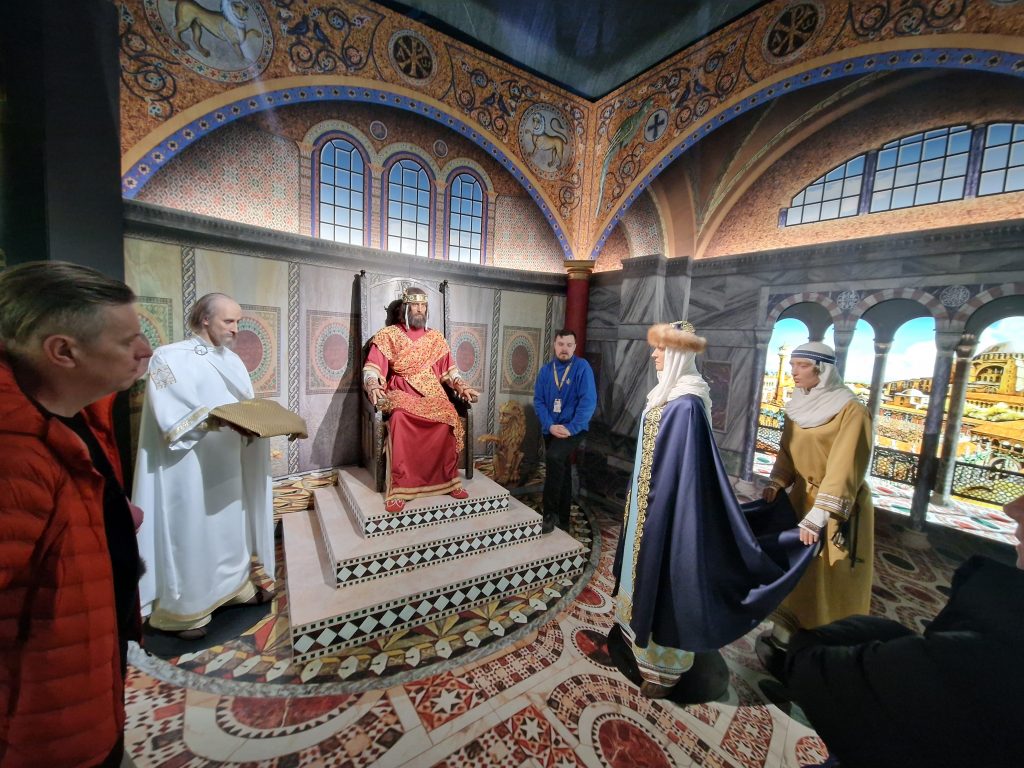
Afterwards, we sit down for cookies and coffee in the museum café, then we meet more SAP colleagues and also visit the National Museum of the History of Ukrainein the same building. The exhibition there begins with a huge candle that was cast from wax collected from all regions of the country. I send Yuliya, our diligent trench candle cook, a picture with a heart. Around it, all the regional Vyshyvanka embroidery patterns are on display. I can’t get enough of looking at them. The main exhibition uses scenes and wax figures to depict people and families from the key eras of Ukrainian history. Starting with Vladimir the Great and Yaroslav the Wise, through Hetman Mazepa, up to the present day. Our museum guide explains to us that more museums are planned or already under construction to continue the presentation. When we leave the building, heavy snowfall has set in, and the temperatures are below zero again.
We walk back to the bus and Yuriy skillfully drives us through the snowy streets. We go to the traditional restaurant Poltava, where we have dinner. Sergey joins us and brings, among other things, self-designed Velcro patches for Pickup4Ukraine—a large number, for all drivers. Yuriy then drives us to the train station. We chose the early night train just after 8 p.m. so that we wouldn’t risk missing our flight home from Krakow the next day.
Nadiia gets in touch: Iryna picked up the KIA and was very happy.
Hardly have we entered the building hall of the train station and passed through the baggage screening when another air raid alarm sounds. The station is evacuated. We are missing Stefan. He sends a message to our group chat: he is already at the platform. The platform is not being evacuated, the train is already there but still closed. The rest of us temporarily walk into a nearby underpass. Then it is time to board the train. We learn that this very underpass leads directly to the platforms, and we meet Stefan at the train above. Despite the air raid alarm, we are able to take our compartment as planned. The conductor assigns us the berth numbers as we board, in Ukrainian. When he notices that I am translating into German, he tells us some numbers in German and asks again how to say 41 in German. I explain it to him, and he is pleased.
The night on the train is very warm, but quiet. The carriage doesn’t rattle over the tracks, but rather rocks and sways like a drunken Mississippi steamboat. Not easy to get used to. At 4:00 a.m., the Ukrainian border control arrives in Mostyska II and collects the passports first. A little later, the customs inspector comes. He can hardly speak any English and asks several times if we have any war souvenirs, cartridges, or shells with us. We say no. He looks at my face for a longer time and then says in Ukrainian that he thinks he remembers me. I, being reminded of my longer stay at customs in October last year, start to feel a bit warm. I play dumb and claim not to understand him. It works. We are not searched. The conductor brings us coffee and tea in the traditional glasses with metal holders and handles.
The train departs again with some delay. We arrive at Przemysl station on a different track than usual. They also seem to have remodeled the access to the border control building. In any case, they are directing holders of EU passports through a separate entrance, fast-track. We get through quickly and sit in a café in front of the station building until departure of our connecting train to Kraków. Stephan takes an earlier train and heads straight home to Germany by rail. The rest of us have booked the flight from Kraków to Frankfurt and leave shortly before eight o’clock. In Kraków, we still have time for a bit of sightseeing in the city center and Wawel, and a delicious Polish lunch, then it’s off to the airport for us as well.
The checks there are done quickly, we eat another salad, then we fly home. Adrian picks us up at Frankfurt Airport and takes us home. Big thank you to Adrian – it is always extremely convenient to be picked up and brought home after a transport. In the car, I realize how tired I am. I fall asleep and only wake up shortly before Heidelberg.
It was a successful transport. We are glad to have delivered four vehicles again. I am happy to have brought a convoy to Kyiv under my own responsibility and am relieved that everything went so well. We are very grateful for the support we continue to receive – both through generous donations, as well as from the people who help us search for, inspect, and procure vehicles, who take on the task of driving a vehicle to Ukraine, who spread our cause and expand our network – THANK YOU VERY MUCH to all of you: You are Pickup4Ukraine.
Now Michael’s transport is imminent next week. Another 8 vehicles and 16 drivers in total. My thoughts are with them. I would like to be there, but I remember Alena’s objection: “You also have to celebrate.”

